

















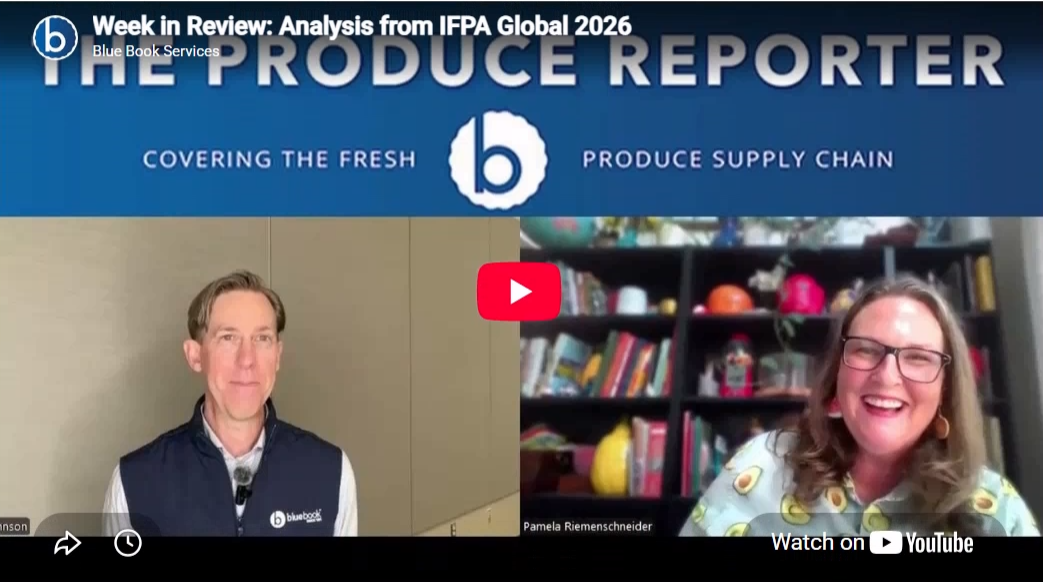
The Produce Reporter Week in Review June 20, 2025
President Trump's policies cause uncertainty, which is bad for business, but he delivered a new trade deal that should benefit U.S. growers.
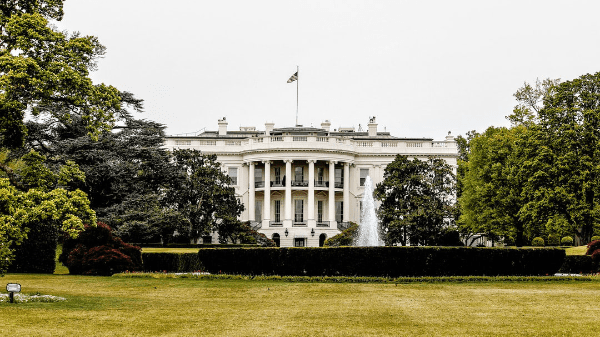
The national news seems to be filled with the American president saying or doing or not doing something every day.
When it comes to produce this week, let’s pick two Trump items, one good and one bad.
The bad is immigration enforcement.
Just as we saw with tariffs, the uncertainty makes it hard to run a business.
As the administration goes about trying to define and deport what it calls “criminal aliens,” this should generally not disrupt produce industry operations.
Early in the week, after lobbying by the agriculture industry among others, the president said he would not go after ag workers to avoid disruptions in the food supply chain.
But then later in the week, he posted in social media that he has instructed agents to conduct the “single largest Mass Deportation Program in History.”
The International Fresh Produce Association issued a member alert with guidance for produce companies to “review this essential information about rights and responsibilities as both employers and individuals.” Ag industry adjusts to uncertainty around immigration enforcement – Blue Book
We will have to see how this plays out to see how the supply chain holds up.
On the positive sign, one of the things Trump said the tariffs would produce is better trade deals with other nations.
This week USDA announced American agricultural producers will have greater market access to Thailand and Vietnam and maintained access to Brazil. USDA announces market access deals with Brazil, Thailand, and Vietnam – Blue Book
The USDA specifically called out that citrus and apple growers will be able to sell more products to Thailand, and stone fruit growers will face lower non-tariff trade barriers in Vietnam.
We will need to see many more of these to get tariffs into the win column for American producers.
Dirty Dozen
Last week the Environmental Working Group (EWG) released its annual shoppers guide discouraging produce consumption, also known as the “Dirty Dozen.”
We were hoping the legacy media would ignore it, and that hasn’t been the case.
The Alliance for Food and Farming’s Teresa Thorne said she provided counter commentary to the EWG with many media outlets.
She noted early coverage was the lowest she’s seen.
“Day-one coverage, where we normally see the highest amount of coverage, was down 46 percent over 2024. And 2024 was the second lowest year of coverage. More notable is that day-one coverage this year was 17 percent lower than 2020, which was the lowest year ever.”
I went on a media tour to find coverage, and it was predictably biased and disappointing, ranging from parroting the EWG’s unscientific biases against conventional produce to sensational media scare tactics. Legacy media still wants to scare with the Dirty Dozen – Blue Book
“Fruits and vegetables are actually bad for you” is the “man bites dog” kind of story that will probably never go away entirely.
Most consumers who see the stories know they’re nonsense and don’t change their shopping patterns.
But research shows when low-income consumers are exposed to “Dirty Dozen” list messaging, they say they are less likely to purchase any produce – organic or conventional.
These are EWG’s victims.
News you need.
Join Blue Book today!
Get access to all the news and analysis you need to make the right decision --- delivered to your inbox.



Subscribe to our newsletter
© 2026 Blue Book Services. All Rights Reserved

