



















Blue Book October to November Score migration remains stable
Of the companies scored in both months, 93% stayed in the same 100-point band, and half of scores moved by just a few points, if at all.

Blue Book Scores held steady from October to November 2026.
Of the companies scored in both months, 93 percent stayed in the same 100-point band, and half of all scores moved by just a few points or not at all.
The companies that did move followed a familiar pattern. Companies in the 600s and 700s were more likely to move up a band than down, while companies in the 800s and 900+ band were more likely to slip. That is the same direction we saw from January to October.
Small monthly shifts add up over a year. If November’s pattern holds, a company in the 800s today has a 59 percent chance of still being in the 800s 12 months from now, and a company in the 700s has about a one-in-three chance of reaching 800 or higher. This analysis looks at what moved this month, then at where each band is likely to be a year from now.
Observed migration, October to November
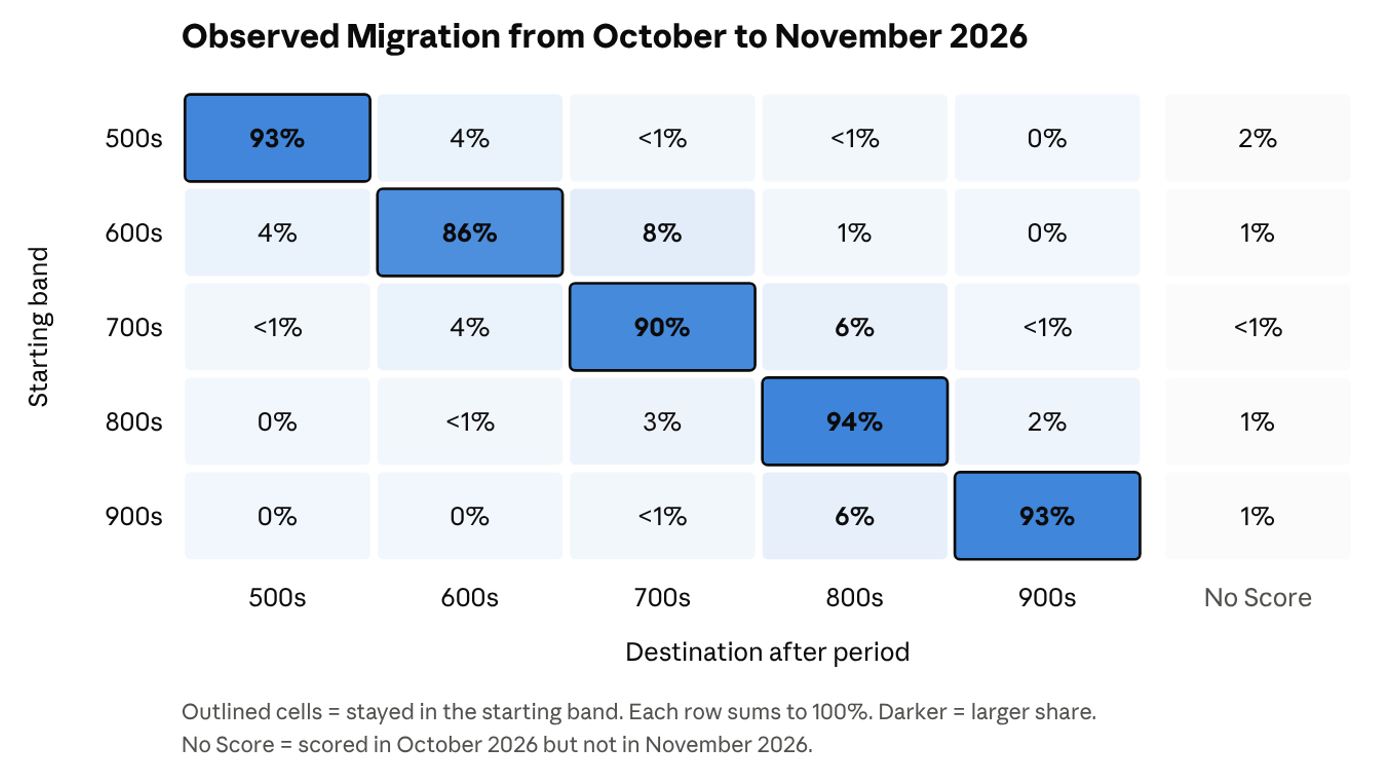
In a single month, between 86 percent and 94 percent of each band held its ground. The action sat just off the diagonal: the 600s and 700s moved up more often than down, and the 900+ band lost 6 percent of its companies to the 800s.
Band by band
500–599: Holding, with a small lift. Ninety-three percent stayed in the 500s, and 5 percent moved up, nearly all of them into the 600s. This band also had the highest share of companies drop out of scoring, at 2 percent in a single month.
600–699: The most active band. At 86 percent, the 600s had the lowest stay rate of any band. About 9 percent moved up, mostly into the 700s, while 4 percent slipped to the 500s, so upgrades outnumbered downgrades about two to one.
700–799: Leaning up. Ninety percent held their band. Of those that moved, slightly more climbed into the 800s (6 percent) than fell into the 600s (4 percent).
800–899: The steadiest band. Ninety-four percent of 800s companies stayed put, the highest rate in the data. Movement was nearly balanced, with 3 percent slipping into the 700s and 2 percent rising to 900+.
900+: Easing at the edge. Ninety-three percent kept a 900+ score. The 6 percent that slipped almost all landed in the 800s, and only one company fell further.
The 12-month probability of migration
Carried forward a year, November’s pattern makes the 800s the most stable band: a company there today has a 59 percent chance of still being in the 800s 12 months from now. No other band has better than even odds of holding its range.
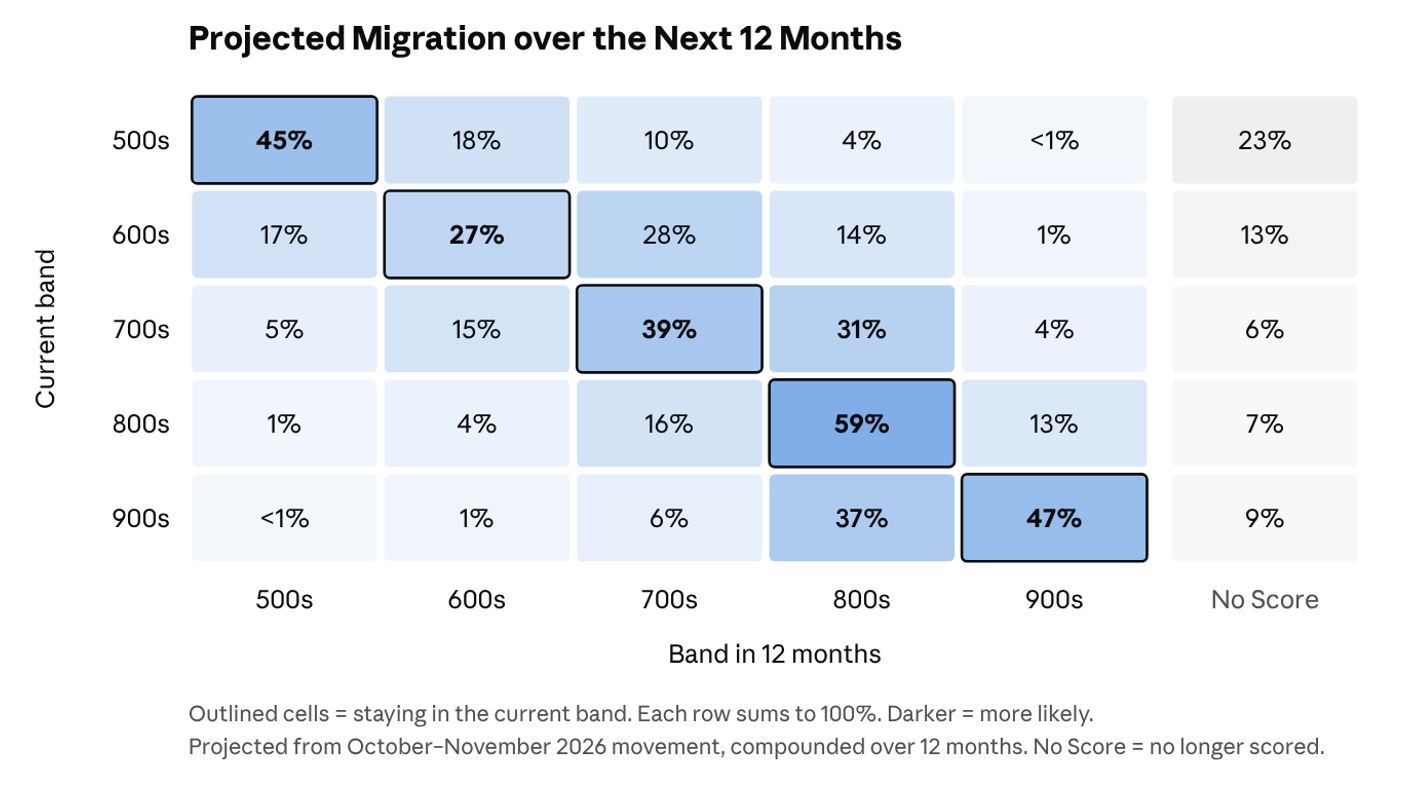
The middle of the scale is where outcomes spread out. A 600s company is about as likely to be in the 700s a year from now (28 percent) as in the 600s (27 percent). A 700s company has a 39 percent chance of staying put and a 35 percent chance of reaching 800 or higher.
At the ends, the picture splits. A 900+ company is nearly as likely to slip into the 800s (37 percent) as to keep its score (47 percent). A 500s company has a 45 percent chance of staying in the 500s and a 23 percent chance of losing its score altogether, against only a 4 percent chance of reaching 800 or higher.
What to watch
- Revisit the 700s. Roughly a third of these companies are on track to reach 800 or higher within a year, so terms set on a 700s score can quickly go stale.
- Look twice at the 600s. This band has the widest range of outcomes: a company here is about as likely to end the year in the 700s (28 percent) as in the 600s (27 percent), yet still has a 17 percent chance of falling to the 500s.
- Don’t set and forget the top. Fewer than half of 900+ companies (47 percent) are projected to keep that score for 12 months. Most that slip land in the 800s, which is still a strong score.
- Watch the 500s for exits. Nearly one in four (23 percent) are projected to lose their score within a year, the highest rate of any band.
- Treat big jumps as a signal. Only 0.5 percent of companies moved 100 points or more in a month, so a sudden large change is worth a closer look.
News you need.
Join Blue Book today!
Get access to all the news and analysis you need to make the right decision --- delivered to your inbox.






Subscribe to our newsletter
© 2026 Blue Book Services. All Rights Reserved

