

















ProduceIQ: Fresh produce prices cool as supply improves, SNAP cuts loom
This year’s Thanksgiving demand could be tempered by the recent expiration of SNAP benefits and the uncertainty of the government shutdown.

Images courtesy ProduceIQ
Thanksgiving demand is building as the annual holiday pull begins. Still, this year’s momentum could be tempered by the recent expiration of SNAP benefits for millions of households and the uncertainty surrounding an extended government shutdown.
With less purchasing power at the consumer level, retail produce demand may soften just as buyers typically ramp up for the holiday season.
November’s outlook calls for above-average temperatures across much of the U.S., supporting some harvest activity and complicating others. Florida stands out as an exception, with cooler-than-normal conditions that could affect short-term production and supply logistics.
ProduceIQ Index: $1.21/pound, +6.1 percent over prior week
Week #44, ending Oct 31st
Blue Book has teamed with ProduceIQ BB #:368175 to bring the ProduceIQ Index to its readers. The index provides a produce industry price benchmark using 40 top commodities to provide data for decision making.
Wet veg, lettuce, and leaf prices pause assault, lean supply persists. Declining prices can be traced to two key factors: improved growing conditions in the West, which have eased insect and disease pressure, and increasing production from Mexican growers. Still, supplies remain lean overall, and markets are far from stable.
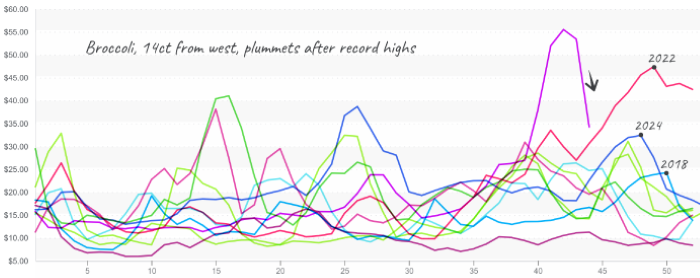
Broccoli prices are hemorrhaging, down -42 percent over the previous week, but remain at a ten-year high for week #44. Improved supply from Mexico and easing insect pressure in Salinas and Watsonville are fueling a dramatic market recovery. Prices are expected to keep sliding as more Mexican growers come online. In short, broccoli isn’t out of the woods yet, but the end is in sight.
Broccoli descends rapidly after reaching record highs
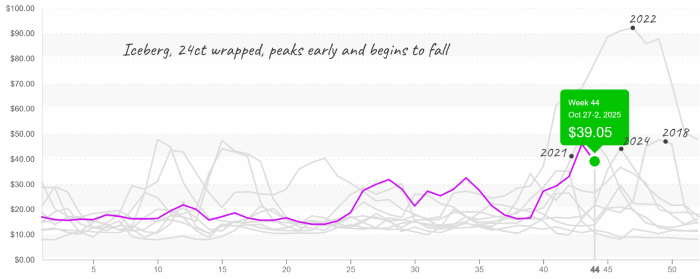
Meanwhile, iceberg lettuce prices also slipped last week, thanks to increased supply from Huron. This brief reprieve, however, is expected to be short-lived. Rapidly declining volume from Salinas and Watsonville will likely create a temporary supply gap too large to fill in the near term.
While iceberg cools off, romaine continues to climb, up another +5 percent over the last week. Insect pressure, INSV, and lingering weather-related quality issues are complicating the transition back to the desert. Growers in Huron have started in a light way, but meaningful volume improvements are still a few weeks out.
Iceberg’s peak softens during time of historical volatility
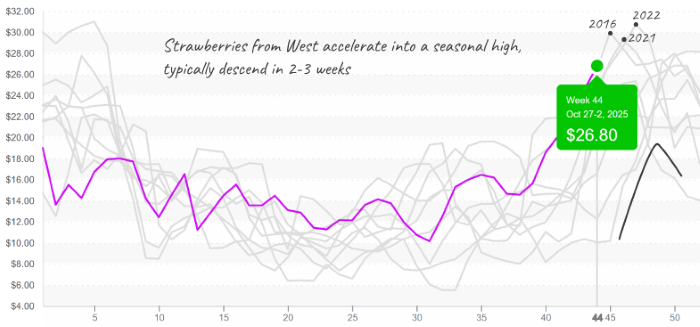
Elsewhere in the produce department, strawberries stand out as the notable outlier in a sea of declining prices. Although weather has improved for West Coast growers, seasonally declining production, accelerated by recent storms in Salinas, Watsonville, and Santa Maria, is keeping prices high. Supplies from Central Mexico and Florida should start to pick up in the coming weeks, helping to ease markets and stabilize supply.
Strawberries ascend slightly earlier than the typical pattern
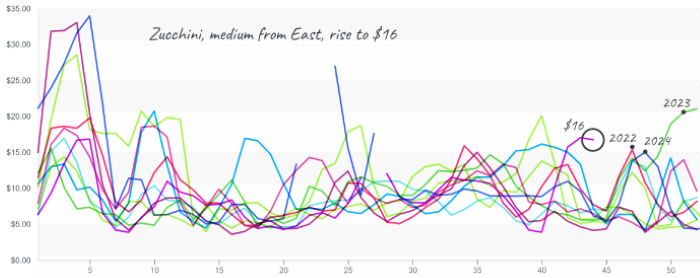
Rounding out the report, zucchini prices remain at a ten-year high. Low volumes from both eastern and western growing regions continue to keep pressure on prices. In the East, cool, wet weather has reduced yields (though quality remains strong), while California’s seasonal decline is shifting the burden to Mexican producers. Supply should improve gradually as producers in Mexico and South Georgia ramp up, allowing prices to stabilize later this month.
Zucchini counters its historical trend as Georgia is late
ProduceIQ saves you time and provides valuable information to increase your profits.
The ProduceIQ Index is the fresh produce industry’s only shipping point price index. It represents the industry-wide price per pound at the location of packing for domestic produce and at the port of U.S. entry for imported produce.
ProduceIQ uses 40 top commodities to represent the industry. The Index weights each commodity dynamically, by season, as a function of the weekly 5-year rolling average Sales. Sales are calculated using the USDA’s Agricultural Marketing Service for movement and price data. The Index serves as a fair benchmark for industry price performance.

News you need.
Join Blue Book today!
Get access to all the news and analysis you need to make the right decision --- delivered to your inbox.







Subscribe to our newsletter
© 2026 Blue Book Services. All Rights Reserved

