
















Week in Review: Retail AI visibility
Retail analyst Ashley Nickle says the research shows that AI algorithms favor retailers with a clear customer value proposition.
Courtesy 5WPR

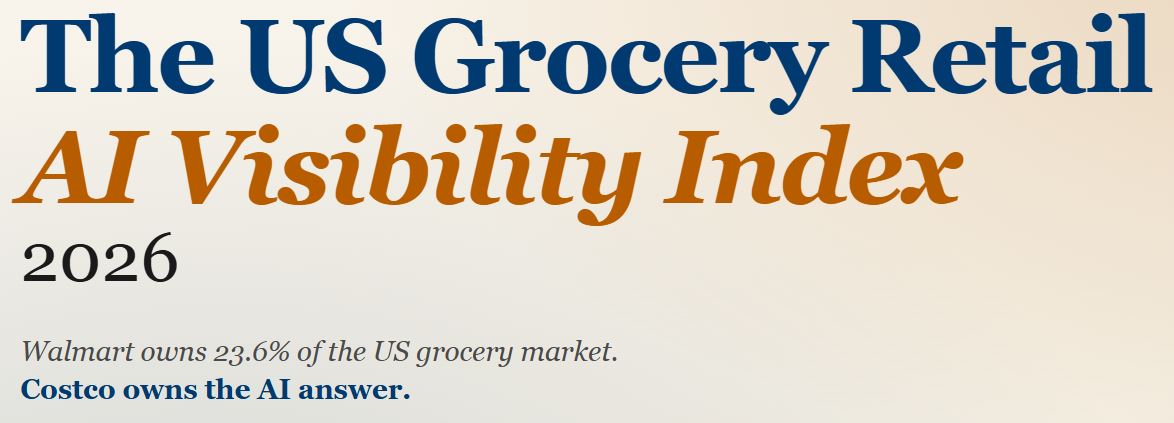
This week, research shows how grocery retailers fare when consumers use artificial intelligence to help with their shopping.
Consumers use AI more often than one would think to help with their grocery planning, and retailers have work to do when it comes to performance in AI engines.
While Walmart commands the most grocery market share, it ranks fourth in AI citation share according to 5WPR, behind Costco, Trader Joe’s, and Whole Foods.
“Market share is a lagging indicator. AI citation share is a leading indicator,” said Ronn Torossian, Founder and Chairman of 5W. “The grocers who close that gap in 2026 will define the category in 2030. Most grocery CMOs we talk to are running 2019 playbooks against 2026 consumer behavior.”
Retail analyst Ashley Nickle of Ashley Nickle Growth Strategies LLC helped me interpret these trends.
“The superlative focus — asking which retailer is best in a certain area, from price to produce to pickup to private label — disadvantages the retailers whose models are geared around being everything to everyone, like Walmart and Kroger,” she says.
“The top three on the most-cited-by-AI list are Costco, Trader Joe’s, and Whole Foods, which are all nontraditional grocers with reputations for excellence in key areas. What this research shows is that, at least in a ‘Which store has the best …’ scenario, algorithms favor retailers with a clear customer value proposition.”
She says Statista shows that 19 percent of consumers use AI-powered tools regularly for food-related activities including meal planning, recipe suggestions, and grocery shopping.
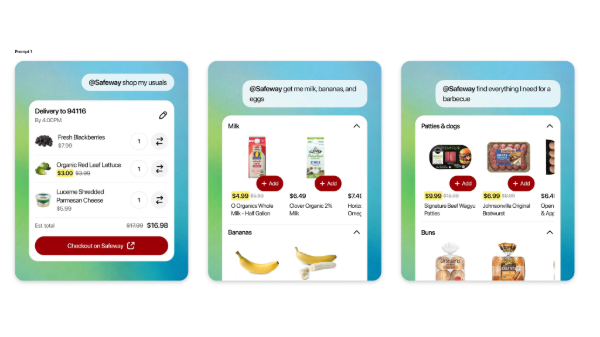
“My impression is that most of the activity right now is ‘pre-shop’ as opposed to the actual purchase, though there are opportunities to do that too, with Walmart and Instacart announcing partnerships with ChatGPT last year.”
Nickle predicts that as more people are required to use AI at work, many will identify ways to use it in their personal lives, too.
Consumers using AI for grocery inquiries often find retail private labels in the AI answers at rates that exceed CPG brands, the research shows.
Nickle says that presents an opportunity for retailers.
“Grocers now have to answer for AI the same question they have to answer for shoppers: ‘Why should I choose you?’” she says. “AI has to be able to explain to the shopper why it’s making a certain choice, and points of difference — like private label — help it do that.”
“It may be harder for a retailer to get credit from AI for a great produce selection, for example, if there aren’t recognizable brands for the AI to cite as reasons to choose that retailer. Those brands could include private label — which, once a reputation is established, could be particularly impactful because it is exclusive to that retailer — as well as premium national brands that not all grocers carry. With that in mind, I’d advocate for grocers to consider where it makes sense to leverage both branded produce and private label produce.”
She says retailers should offer existing brands that customers already associate with quality and look for opportunities to put their own brand on products with which they would be proud to be associated.
Finally, Nickle says the report calls out recipe and meal-planning content as a “hidden AI citation driver.”
“It says that grocers with strong infrastructure in this area will benefit,” she says. “That’s a noteworthy callout for produce suppliers, too.”
News you need.
Join Blue Book today!
Get access to all the news and analysis you need to make the right decision --- delivered to your inbox.






Subscribe to our newsletter
© 2026 Blue Book Services. All Rights Reserved

