


















Week in Review: When do fuel prices change consumer behavior?
So far, grocery executives say they haven’t seen much change in their customers’ behavior due to rising fuel prices.
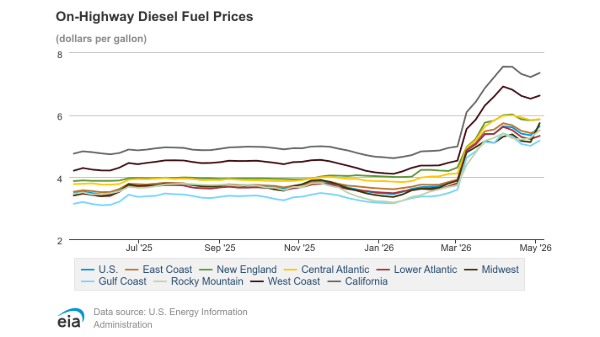
Gasoline and diesel prices keep rising as the U.S. conflict with Iran continues to push up oil prices, and the Gulf of Hormuz goes through periods of being open and closed seemingly daily.
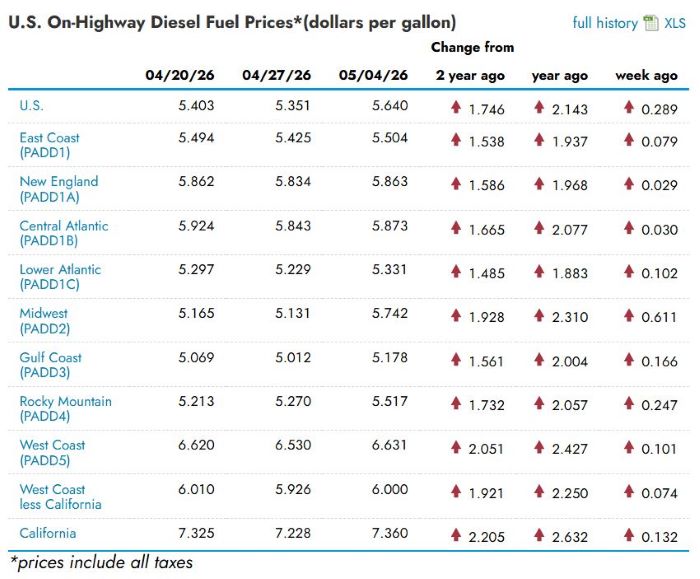
Regular gas prices rose to a national average of $4.45 per gallon this week, up 33 cents from last week and $1.30 from a year ago. Diesel prices rose to $5.64 per gallon nationally, up 29 cents from a week ago and $2.14 from a year ago.
The Midwest saw the biggest jumps this week, rising 51 cents per gallon for gas and 61 cents per gallon for diesel.
Dean Croke, Industry Analyst for DAT Freight & Analytics, said the cost of shipping fresh produce continues to rise, as produce-specific shipments average $3.84 per mile, higher than the reefer average of $2.36 per mile.
Fruit and vegetable shipping rates are up from $3.49 per mile last April.
Government inflation figures for April should be out next week, and expect fresh produce to see increases that we didn’t see during earlier months due to fuel and weather issues.
The obvious question is, when will consumers change their grocery shopping behavior due to higher fuel prices and possible increasing food inflation? So far, grocery executives say they haven’t seen much change in their customers’ behavior.
“I am probably more constructive on the consumer than what one would glean from reading the headlines of news publications,” said Walmart CFO John David Rainey said during a forum in April, according to a Grocery Dive story. “There’s a lot of alarmist headlines [about] what the impact can be on the consumer. But the consumer continues to be very resilient.”
I agree with him that consumers are more resilient — or one might even say stubborn — when it comes to changing behavior. Are we likely to avoid summer road trips because gas prices are higher or will we adjust to the cost and deal with it? I bet on the latter.
Likewise, consumers have gotten used to food inflation, begrudgingly, and have already made adjustments to their routines, so they aren’t as likely to make more at this point to rising gas prices.
I think many consumers expect the Iran conflict to be wrapped up any time and the flow of oil returned to pre-war levels.
Consumers are generally optimistic but also tend to have long memories when it comes to the feeling of being gouged.
The longer fuel prices stay high, we have to consider who consumers will hold accountable.

News you need.
Join Blue Book today!
Get access to all the news and analysis you need to make the right decision --- delivered to your inbox.






Subscribe to our newsletter
© 2026 Blue Book Services. All Rights Reserved

