

















ProduceIQ: Florida supply brings long-awaited tomato relief
While a few commodities are finally trending in the right direction, others remain stubbornly volatile as the industry looks towards summer.

Images courtesy ProduceIQ
Summer unofficially arrives in the produce industry long before the calendar says so.
Falling tomato prices and the first signs of easing spring transition signal smoother sailing ahead for buyers. However, while a few commodities are finally trending in the right direction, others remain stubbornly volatile as the industry looks towards its summer season.
ProduceIQ Index: $1.26/pound, down -8.03 percent over prior week
Week #19, ending May 8th
Blue Book has teamed with ProduceIQ BB #:368175 to bring the ProduceIQ Index to its readers. The index provides a produce industry price benchmark using 40 top commodities to provide data for decision making.
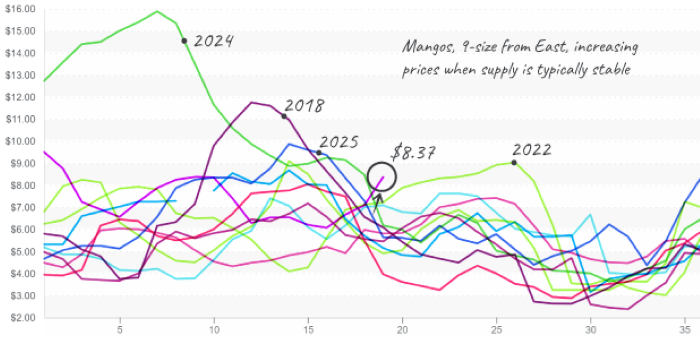
It’s the most wonderful time of year again, and no, we aren’t talking about December. It’s May, and barbecue, flip-flops, sunburns, and South Florida mangoes are back in season. While most mango supply is arriving from Mexico as the season ramps up, a lucky few can still score local deals from the endangered, but enduring, South Florida grower.
And if you are especially fortunate and live there, summer sometimes means a neighbor showing up with what is arguably the best thing about the season in the Sunshine State.
Unfortunately for buyers, peak-season excitement is colliding with one stubborn reality: supply remains unusually tight. Average mango prices are at a ten-year high. A lighter import supply is keeping prices elevated at a time when markets typically begin to ease. This year, mango prices could remain elevated throughout the peak season due to insufficient supply from Mexican growers.
Mangos
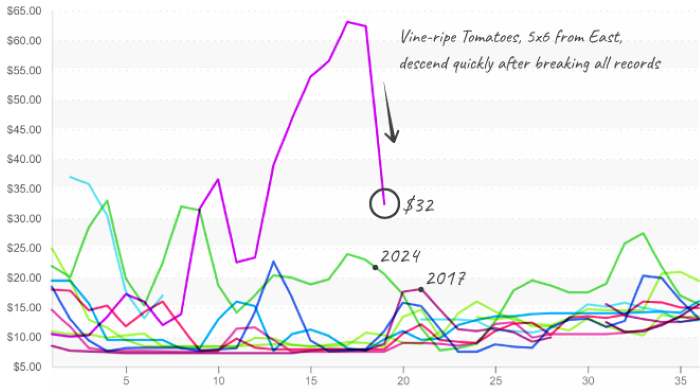
Tomato and mango markets don’t often have much in common, but this week, increasing production out of Florida is providing relief for both commodities. Months of tariffs and weather disruptions in both Florida and Mexico kept round and Roma markets elevated. Now, meaningful relief is finally arriving.
Round prices are down -39 percent, Roma prices -38 percent, and grape-type tomatoes -27 percent over the previous week. Supply and quality are expected to steadily improve over the next few weeks. Looks like Gen Z may still get its tomato girl summer after all.
Tomatoes
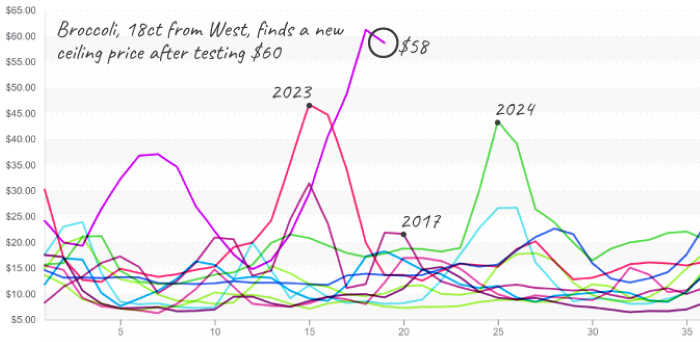
After weeks of elevated pricing, broccoli and cauliflower markets are finally beginning to ease. Although supply is slowly increasing out of Salinas/Watsonville, price volatility is forecast to persist for at least a couple more weeks.
Broccoli
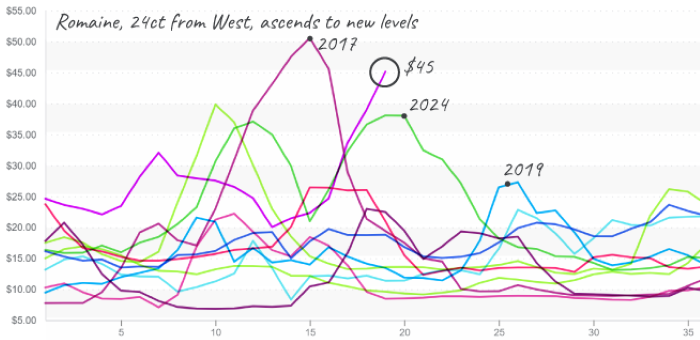
Unlike broccoli and cauliflower prices, romaine markets are finding no relief in the West. Average prices rose another +19 percent over the previous week to a ten-year high. Persistently high temperatures and unusually light Salinas volume continue to crush hopes for near-term relief.
Romaine
ProduceIQ saves you time and provides valuable information to increase your profits.
The ProduceIQ Index is the fresh produce industry’s only shipping point price index. It represents the industry-wide price per pound at the location of packing for domestic produce and at the port of U.S. entry for imported produce.
ProduceIQ uses 40 top commodities to represent the industry. The Index weights each commodity dynamically, by season, as a function of the weekly 5-year rolling average Sales. Sales are calculated using USDA Agricultural Marketing Service data on movement and prices. The Index serves as a fair benchmark for industry price performance.

News you need.
Join Blue Book today!
Get access to all the news and analysis you need to make the right decision --- delivered to your inbox.






Subscribe to our newsletter
© 2026 Blue Book Services. All Rights Reserved

