

















ProduceIQ: Tariffs return as freeze squeezes supply
For fresh produce markets, the long-term policy implications of tariffs could be meaningful, but short-term prices remain largely unaffected.

Images courtesy ProduceIQ
Lighting up the news cycle once again, tariffs are back in the spotlight. The Supreme Court struck down President Donald Trump’s tariffs imposed this past year via executive orders.
In response to the court’s decision, the president issued another executive order under a different law, levying a 15 percent tariff on all countries that will remain in effect for 150 days. Apparently, cats and tariffs both have nine lives.
The question now turns to the billions of dollars already collected from importers by the U.S. government. In a recent interview, the president suggested the funds will likely remain tied up as the courts sort through the mechanics of potential refunds. While the door appears at least slightly ajar for repayment at some point, the process would almost certainly be vague, protracted, and layered in bureaucracy.
ProduceIQ Index: $1.13/pound, up -6 percent over prior week
Week #8, ending Feb 20th
Blue Book has teamed with ProduceIQ BB #:368175 to bring the ProduceIQ Index to its readers. The index provides a produce industry price benchmark using 40 top commodities to provide data for decision making.
For fresh produce markets, the long-term policy implications could be meaningful. In the short term, however, pricing across most commodities is expected to remain largely unaffected.
Shifting from Washington to weather, it may not feel like it to growers across the Eastern U.S. this morning, but we are just 100 days out from the start of the Atlantic hurricane season. The National Oceanic and Atmospheric Administration is forecasting a transition from La Niña to El Niño by September. If realized, that shift could favor a quieter storm season along the East Coast, as El Niño’s increased wind shear tends to suppress Atlantic hurricane development.
That longer-term outlook offers little comfort this week. It’s chilly across the East Coast, especially in Central Florida, where growers are facing their second round of overnight freezes this February. The frigid start to the week will do little to boost supplies of bell peppers, sweet corn, cucumbers, squash, celery, and beans.
Bell pepper markets remain under the weather following the historic Florida freeze. Average prices are hovering near a ten-year high as green bell supply sits firmly in a demand-exceeds-supply pattern on both coasts. Colored bell peppers are faring somewhat better, supported by increasing Western volume. Still, volatility across both green and colored markets is expected to persist through March and potentially into April.
Pepper prices near 10-year high after Florida freeze tightens supply

Strawberries, on the other hand, are staging a healthy rebound in the Sunshine State. Average prices are down -40 percent week over week, even with lighter California supply due to rainy weather. Some short-term fluctuation is possible over the next two weeks as warmer temperatures stabilize production, but the broader trajectory should remain downward through March.
Strawberry prices fall 40 percent as Florida supply rebounds

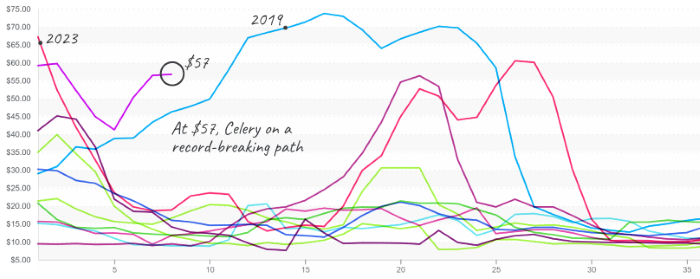
Celery supply remains tight, though quality is reportedly improving. Average prices climbed another +15 percent over the previous week, extending a historic run at a ten-year high for the sixth consecutive week. Elevated markets are expected to persist through March as supply slowly recovers.
Celery prices rise 15 percent extending 10-year high run
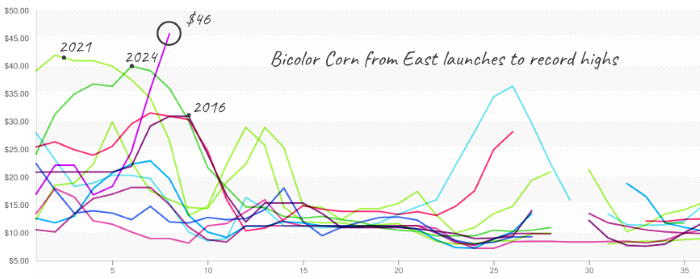
Sweet corn couldn’t let celery have all the glory. Average prices surged +45 percent over the previous week, pushing markets to a ten-year high. According to USDA data, Florida’s week #8 volume is down 80 percent compared to last year. Mexican growers are working to bridge the sizeable supply gap, but volatility is expected to remain a defining feature of the sweet corn market through March.
Sweet corn jumps 45 percent as Florida volume plunges
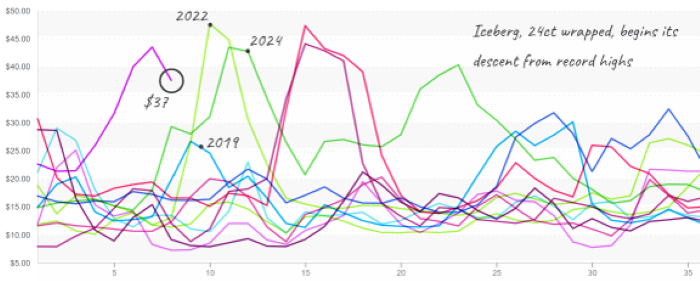
Hope glimmers in the distance for lettuce buyers, though stability remains just out of reach. Iceberg, romaine, and spinach prices all declined week over week amid improved supply and lighter demand. However, the seasonal transition out of Yuma, Arizona, will keep markets on edge through early spring, as shifting production regions tend to bring uneven quality and sporadic supply disruptions.
Lettuce prices ease amid transition out of Yuma, AZ
ProduceIQ saves you time and provides valuable information to increase your profits.
The ProduceIQ Index is the fresh produce industry’s only shipping point price index. It represents the industry-wide price per pound at the location of packing for domestic produce and at the port of U.S. entry for imported produce.
ProduceIQ uses 40 top commodities to represent the industry. The Index weights each commodity dynamically, by season, as a function of the weekly 5-year rolling average Sales. Sales are calculated using USDA Agricultural Marketing Service data on movement and prices. The Index serves as a fair benchmark for industry price performance.

News you need.
Join Blue Book today!
Get access to all the news and analysis you need to make the right decision --- delivered to your inbox.








Subscribe to our newsletter
© 2026 Blue Book Services. All Rights Reserved

