

















Fraud in produce is about to get harder to detect. Here’s what’s coming.
Blue Book’s 2026 Produce Fraud Forecast identifies five escalating threats — and introduces a new tool to stop the most dangerous one.
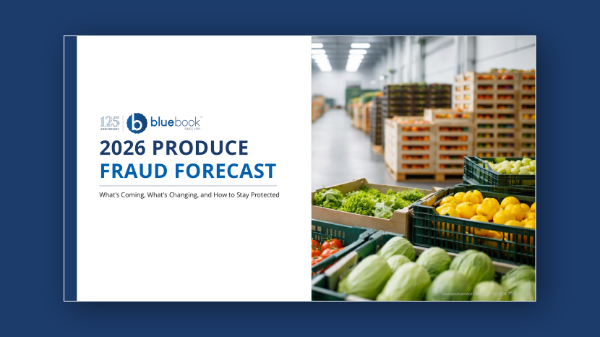
Blue Book’s 2026 Produce Fraud Forecast identifies five escalating threats — and introduces a new tool designed to stop the most dangerous one.
The fraud tactics targeting the produce industry in 2026 look fundamentally different from those of even two years ago. They’re faster, more sophisticated, and increasingly difficult to distinguish from legitimate business activity.
That’s the warning at the center of the 2026 Produce Fraud Forecast, a new report from Blue Book Services released this week.
Rather than looking backward at what happened last year, the Forecast is built to help produce companies see what’s coming — identifying five fraud trends that Blue Book’s analysts expect to escalate over the next 12 months based on patterns emerging across the company’s intelligence network of more than 50,000 member companies, $50 billion in tracked accounts receivable, and hundreds of active fraud and dispute cases.
The picture it paints is not reassuring.
What’s Changing in 2026
The most significant shift is the role of artificial intelligence. The report’s top-rated threat, AI-Enhanced Impersonation, describes a new category of fraud that barely existed 18 months ago: ghost companies built entirely by AI. Professional websites, near-identical email domains, fabricated trade references, cloned PACA license numbers — all generated in hours rather than weeks. These aren’t sloppy fakes. They’re sophisticated enough to pass the kind of surface-level verification that most produce companies still rely on.
The second trend, Seasonal Surge Exploitation, isn’t new in concept but is accelerating in precision. Fraudsters are increasingly timing their approaches to coincide with specific commodity windows — California strawberry and citrus season in spring, stone fruit and berry volume in summer, holiday greens in fall — targeting the exact periods when teams are moving fastest and credit checks are most likely to be abbreviated or skipped entirely.
Transportation Infiltration is emerging as bad actors find new ways to insert themselves into the logistics chain. The Forecast documents a growing pattern of fraudulent carriers and brokers intercepting loads, rerouting shipments, and exploiting the fragmented, trust-dependent structure of produce transportation.
Payment System Manipulation, particularly Business Email Compromise, continues to account for the largest individual losses. The Forecast walks through the anatomy of a BEC attack in produce: a fraudster monitors email traffic between two trading partners, learns the rhythm and tone, then sends “updated” wire instructions from a domain one character off at the moment of settlement. It’s not a technology hack — it’s a timing exploit that targets accounts payable teams under pressure.
Finally, Newcomer Targeting reflects a shift in who fraudsters are going after. Smaller operators and companies expanding into new markets are increasingly in the crosshairs — organizations with thinner credit teams, fewer verification steps, and less institutional memory to flag something that doesn’t look right.
The Common Thread
Across all five trends, the Forecast identifies a single structural vulnerability: verification that relies on a single source. One phone call. One reference check. One website that looks right. When fraudsters can fabricate all of those in hours, single-source verification becomes a single point of failure.
That insight is what led Blue Book to develop the second piece of this week’s announcement.
Blue Book Verify: Stopping Impersonation at the Point of Contact
Alongside the Forecast, Blue Book is launching Blue Book Verify, a new real-time identity confirmation tool built specifically to address impersonation — the common thread running through the report’s most critical threats.
The mechanism is deliberately simple. Before completing a transaction with a new or unfamiliar counterparty, a Blue Book member generates a unique one-time verification code. They share the code with their trading partner, who confirms it — proving in real time that both parties are who they claim to be.
If a counterparty can’t produce a code, the member has an immediate, objective signal to stop and investigate before money or product changes hands.
“Every produce company should make Blue Book Verify part of their standard operating procedure,” said John Glassmire, CEO of Allstate Produce BB #:167514. “This is how the industry protects itself.”
Verify is available to all current Blue Book members. Companies interested in learning how it fits into their existing workflow can visit Blue Book Verify or request a demo.
A Layered Defense
Blue Book is framing the Forecast and Verify as part of a broader, layered approach to fraud defense: the Blue Book Credit Score for ongoing risk monitoring across 50,000+ companies, Verify for real-time identity confirmation at the point of contact, transportation ratings for carrier and broker due diligence, and a claims and collections team that recovered more than $10 million for members in the past year.
The argument the Forecast makes, implicitly, is that no single tool is sufficient anymore. The fraud landscape in 2026 demands layers — and the companies that build those layers now will be the ones still standing when the next wave hits.
Read the Full Forecast
The 2026 Produce Fraud Forecast is available as a free download at bluebookservices.com/2026-produce-fraud-forecast. The report includes the full analysis of all five trends, role-specific risk profiles for operations, purchasing, and executive teams, and a step-by-step preparedness playbook.
Blue Book is also hosting a live webinar on Tuesday, April 21, walking through the Forecast’s findings and the tools available to act on them. Register for the webinar here.
News you need.
Join Blue Book today!
Get access to all the news and analysis you need to make the right decision --- delivered to your inbox.







Subscribe to our newsletter
© 2026 Blue Book Services. All Rights Reserved

