
















The Produce Department of Tomorrow: Emerging tech at point of sale
Technology continues to reshape grocery store operations from the backroom to the checkout counter—what's trending?
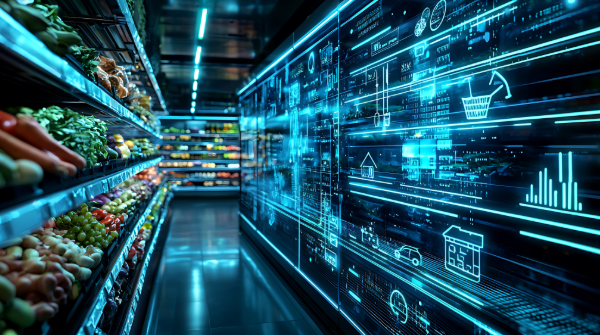
AI Background/Adobe Stock
In this article

The produce department has long been the heart of grocery stores, where freshness, quality, and customer experience intersect. Today, emerging technologies are revolutionizing how retailers manage inventory, price products, and reduce waste in this critical department.
From electronic shelf labels to artificial intelligence-powered produce recognition, these innovations are reshaping operations from the backroom to the checkout counter.
The Digital Pricing Revolution
Electronic shelf labels (ESLs) are rapidly replacing traditional paper price tags in grocery stores across America.
The global ESL market was valued at $1.85 billion in 2024 and is projected to reach $7.54 billion by 2033, reflecting the technology’s growing importance. Walmart has announced plans to deploy ESLs in 2,300 stores by 2026, while Kroger, Whole Foods, and Aldi have already adopted the technology.
For produce departments, ESLs offer unique advantages. Waterproof versions are engineered for environments requiring rigorous sanitation, performing reliably where moisture resistance is essential.
These digital tags enable real-time shelf-life monitoring, allowing managers to track expiration dates and automatically apply discounts to items approaching their sell-by date, reducing food waste by up to 15 percent according to industry reports.
The labor savings is substantial. Employees spend about 80 percent less time on price updates after switching to ESLs. Price changes that previously took associates two days can now be executed in seconds through a mobile app, freeing staff to focus on customer service and product quality.
Price changes that previously took associates two days can now be executed in seconds through a mobile app, freeing staff to focus on customer service and product quality.
Produce Recognition at Checkout
Computer vision and artificial intelligence (AI) are addressing one of produce’s most persistent challenges: checkout friction. Traditional self-checkout systems require customers to manually search for product codes, leading to delays and errors.
Today, AI-powered recognition technology uses cameras and machine learning to instantly identify fruits and vegetables, even distinguishing between similar items like red and green apples or different pepper varieties.
European grocer testing vision AI saw customers spend significantly less time at self-checkout, with store employees experiencing a 50-percent reduction in produce-related interventions.
Research shows individual or loose fruits or vegetables can account for up to 30 percent of total self-checkout transaction time, making this technology particularly valuable for high-volume stores.
Beyond checkout, computer vision can also monitor inventory levels, automatically detecting when shelves run low and notifying staff for restocking.
RFID Technology Enters Fresh Categories
Radio-frequency identification technology (RFID), already common in apparel retail, is making significant inroads into fresh departments.
In October 2025, Walmart and Avery Dennison announced a first-to-market solution bringing RFID-enabled labels to meat, bakery, and deli departments, addressing the longstanding challenge of using RFID in high-moisture, cold environments like refrigerated cases.
Kroger is rolling out RFID tags to bakery items across its 2,750 stores, with plans to expand to proteins and leafy greens. By giving each item a unique digital identity, associates can instantly know product freshness, enabling better inventory management and smarter markdown decisions.
The technology also supports food safety requirements, allowing products to be quickly identified and removed during recalls.
Using AI-powered demand forecasting helps retailers align inventory with real-time demand, with some reporting waste reductions of up to 40 percent while increasing product availability.
Tackling Food Waste
Approximately 30 percent of food in grocery stores is thrown away, with fresh produce items comprising a significant portion of this total.
Using AI-powered demand forecasting helps retailers align inventory with real-time demand, with some reporting waste reductions of up to 40 percent while increasing product availability.
Food waste apps are also making a dent, diverting millions of pounds of perishables away from landfills while saving shoppers money on less-than-perfect produce and other near-expiry food items.
Looking Ahead
For growers, shippers, and retailers, these technologies represent both opportunities and imperatives.
Electronic shelf labels enable dynamic pricing, which can move product efficiently, yet not without controversy—as some shoppers and consumer groups have concerns over the ease of changing prices. The use of RFID tracking has many positives but demands closer supply chain coordination.
Having AI systems at checkout and elsewhere improves efficiency but requires quality and consistency in produce items so cameras can reliably identify them.
Despite hiccups or minor issues with these tools, however, the return on investment is compelling.
Most stores see ESL receive payback within 18 to 24 months, and RFID implementations reduce inventory management time from hours to minutes a day. As competition intensifies and margins remain thin, the produce department of tomorrow will be built on the digital infrastructure being deployed today.
News you need.
Join Blue Book today!
Get access to all the news and analysis you need to make the right decision --- delivered to your inbox.








Subscribe to our newsletter
© 2026 Blue Book Services. All Rights Reserved

