



















Mark Campbell, ProduceIQ
If you're not familiar with Mark Campbell or ProduceIQ, you're not mastering the art of data. Find out what you're missing here.
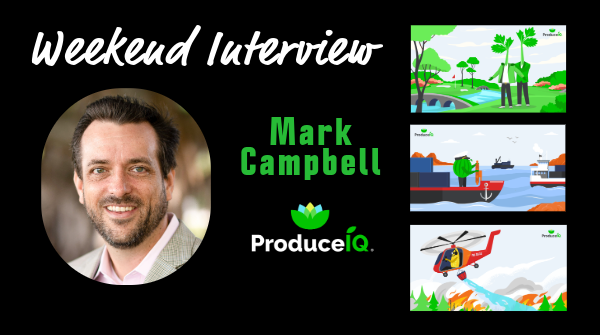
Featured artwork by Yuliia Russu.
In this article
One might say Mark Campbell’s ‘produce IQ’ is pretty high, given his years in the industry and financial acumen. He solidified that knowledge and expertise by cofounding ProduceIQ, Inc. BB #:368175, to provide crucial real-time market data to buyers and sellers of fresh produce.
Based in Palm Beach Gardens, FL, Mark is a unique participant in the food supply chain with ProduceIQ and as the owner of two restaurants. We asked him for the lowdown on both.
Q: Tell us about your background and education.
I’ve participated in all the financial roles of our industry, starting as a lender for Farm Credit, then a private equity investor, and finally as the corporate CFO for a variety of grower-shippers. Similar to most of the students at Columbia Business School, I concentrated on finance; however, I was probably the only person interested in agriculture.
In 2016, I left “corporate” to become more entrepreneurial and became CFO of Finance of Food consulting services. This led to many engagements advising fresh produce companies throughout our industry.
Q: What were your earliest career aspirations and how did you end up in the produce industry?
As relationships drive most careers, mine was no different. I had met Chris Erneston, of J&J Produce, Inc. early in my career, and he convinced me to return to help his family’s company as CFO.
It was there that I learned the details of our industry, from farming to packinghouse operations, transportation, and sales. His family was very good to me and taught me the reasons why this industry is so relationship driven.
If we’re brutally honest, our industry is slow to change.
Q: What sparked the idea for ProduceIQ?
It was, and remains, difficult to explain to an outsider how the sales process (trade) works in the fresh produce industry. McKinsey did a study on digital transformation claiming that of 24 industries, agriculture was second to last (ranked 23rd), being more advanced than only construction.
I know that our industry has many opportunities for innovation. We can be more transparent, more fair, and more efficient. If we’re brutally honest, our industry is slow to change. However, we do make continual progress, and I anticipate the produce world will look much different in 10 to 20 years.
Ultimately, ProduceIQ is focused on becoming the authority on prices, providing actionable information to improve decision making.
Q: How long did it take to work out the particulars and launch?
Since 2019 ProduceIQ has continued to develop and adapt to what the market is telling us is important. At the beginning, I made more assumptions about pain points and solutions. Today, our pipeline is much more customer centric, solving problems that are brought to us.
Yet it feels like we’re still “launching.” We continue to develop new products and move towards a vision for what the industry needs 5 to 10 years from now. I joke that in 10 more years, the industry will call us an overnight success.
Q: So what exactly is ProduceIQ? What does it offer, how is it delivered, and who benefits?
We’ve evolved to sell data and SaaS (software as a service) tools that help suppliers and buyers to better understand prices, markets, and trading strategies. For both buyers and suppliers, we offer normalized USDA data, APIs (application programming interfaces), and benchmarking tools.
For buyers, we support with RFP (request for proposal) software, program builders, price sheet data/ introductions; for suppliers, we’re currently launching TrueMarket, which provides better quality data than the USDA (as it’s aggregated from accounting systems), and in real time.
We’ve evolved to sell data and SaaS tools that help suppliers and buyers to better understand prices, markets, and trading strategies.
Q: Walk us through an average day: what changes on a daily, weekly, or monthly basis?
My average day changes quite a bit. However, the consistent part is a morning call with our IT development team, our sales team, and a few client calls. After that, I’m scrambling to scratch off my sticky notes.
Q: Do you travel much, meeting with suppliers or visiting growers?
I’m fortunate to not travel as much anymore as I prefer to focus on family. During the first year of ProduceIQ, I probably did all 15 or so industry trade shows. Now, it’s become normal and actually easier to demonstrate software through Zoom.
Q: What tech tools are most essential to what you do?
Our development team uses the Microsoft stack; our marketing uses HubSpot. In my role, I mostly use our own ProduceIQ software, particularly when I write content for Blue Book. [Editor’s note: Blue Book’s twice-daily newsletter, The Produce Reporter, publishes ProduceIQ insights every Monday morning, like this one.]
Q: How do you ensure accuracy? Have you ever gotten something wrong?
Of course, humans (and AI) make mistakes! That said, I’m a bit of a perfectionist. As a CFO, I learned early in my career that presenting a wrong number, even if inconsequential, will typically cause your audience to turn off. We’re always striving for accuracy as it’s necessary for trust.
Q: What do you enjoy most about your job? What’s most difficult?
I enjoy the innovation. It’s cool to bring an early-morning idea into a fully executed (and automated) software tool. We really have an amazing team—that’s so much more skilled than I am—in each of their areas of expertise.
We pride ourselves on what’s most difficult. We take messy raw data and make it useful, helping clients improve their daily workflow and decision making.

Q: Tell us about the fun, whimsical illustrations.
Our graphic designer, Yuliia Russu, is a true artist. She works every Sunday night to deliver an eye-catching image that captures our produce content as a part of the global news. We’re blessed to have her on the team!
Q: What’s your vision for ProduceIQ for the rest of decade? Any plans for expansion?
As we master each level of price data, we’ll improve our forecasting. Ultimately, our clients are hungry for more than raw data, they seek analysis and guidance. We will continue to grow our product offerings over the next decade, focusing on solving specific client needs.
Q: From your vantage point, what trends (or challenges) in the industry will have the most impact this year?
Narrow margins and high volatility are constant challenges in our industry. The highly perishable nature of our products will continue to bring the unexpected.
Q: What do you consider the weakest links in today’s supply chain? How can they be improved?
Our #1 focus is to develop a true, accurate understanding of market prices. We’re delivering it “live” so the data is actionable.
Q: Your website mentions you own a restaurant in Florida, is it casual or upscale?
Yes! I own a casual seafood and sushi restaurant called Hog Snappers. And we recently acquired a local brewery, developing a state-of-the-art Texas Smokehouse to bring the best BBQ to Florida. Come and visit us near Jupiter, FL!
At the restaurants, I definitely work “on the business” and not “in the business.”
Q: Are you a hands-on or hands-off type of owner? How much does fresh produce influence the menu?
At ProduceIQ, though I certainly delegate, I’m hands-on with the product vision and understanding customer needs. At the restaurants, I definitely work “on the business” and not “in the business.” I’ve still never entered an order on the POS (point of sale) system.
Fresh produce plays an important role; however, the proteins are dominant. Fresh produce comprises only about 15 percent of total food costs with our top produce item being avocados. Yet I still love seeing our industry’s suppliers represented in our kitchen.
Q: Where do you see yourself in five years? Is there an elusive personal or professional goal you would like to achieve?
Hopefully, in five years, I’ll learn to relax a bit. I look forward to having more balance, spending more time with my kiddos.
Q: Anything else you’d like share with our readers?
I’d encourage our industry to adopt innovation. Change is difficult, though inevitable. Technology should help us have more time for relationships, but it will never replace relationships.
News you need.
Join Blue Book today!
Get access to all the news and analysis you need to make the right decision --- delivered to your inbox.






Subscribe to our newsletter
© 2026 Blue Book Services. All Rights Reserved

