

















ProduceIQ: North America kicks around USMCA’s future
As the USA, Mexico, and Canada jointly host the 2026 FIFA World Cup, there's renewed uncertainty over the future of trade.
Images courtesy of ProduceIQ.
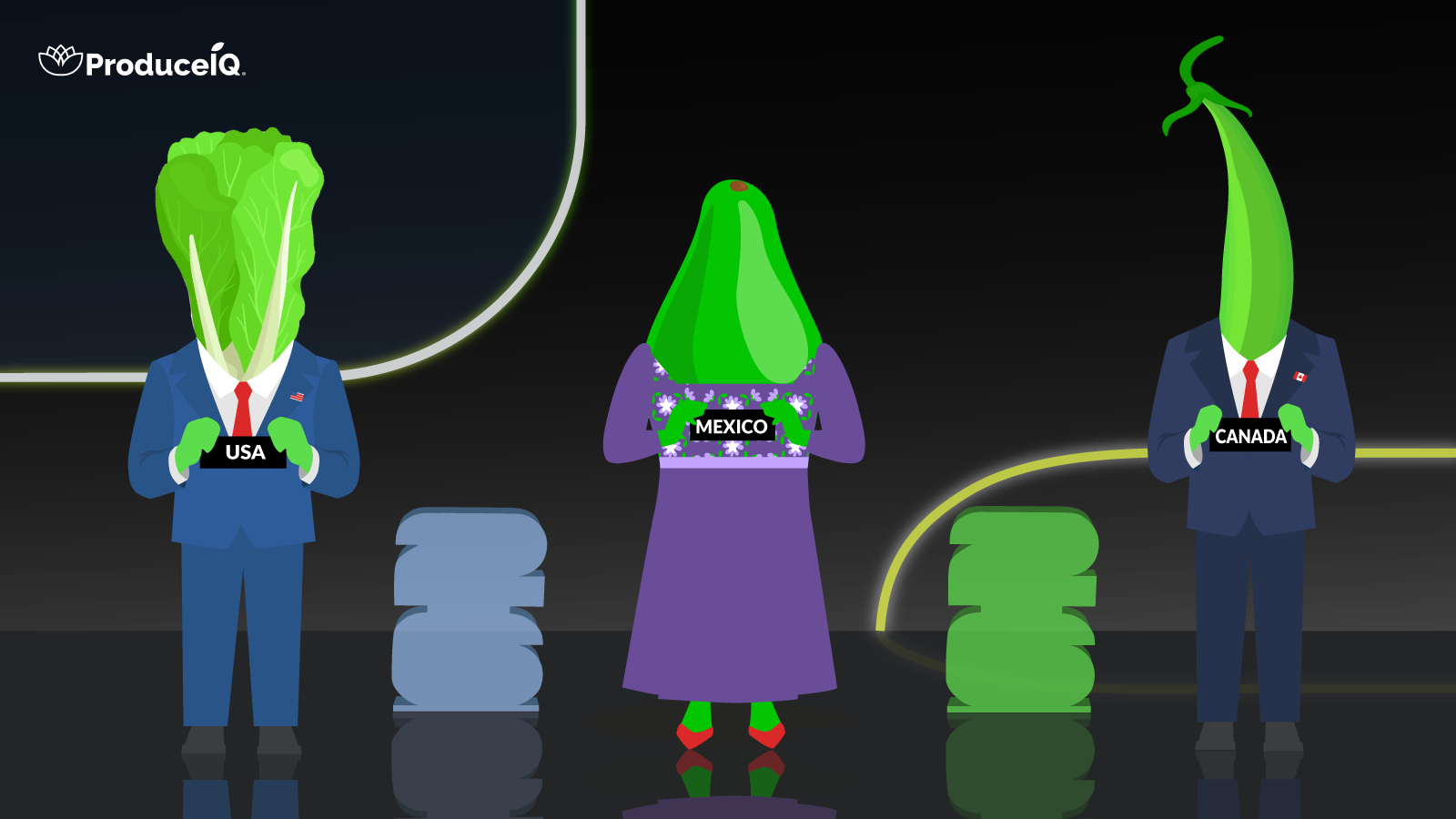
As the United States, Mexico, and Canada prepare to jointly host the 2026 FIFA World Cup, the three countries appear headed toward renewed uncertainty over the future of their most important trade agreement.
Officials now expect the countries to miss a July 1 milestone to extend the U.S.-Mexico-Canada Agreement (USMCA), potentially setting the stage for years of negotiations over tariffs, manufacturing rules, and market access.
The timing is hard to ignore. Hosting the world’s largest sporting event will require unprecedented coordination across North America, with fans, workers, and goods moving freely throughout the region. At the same time, the three trading partners are revisiting the agreement that underpins nearly $2 trillion in annual trade.
Since replacing NAFTA in 2020, USMCA has helped provide stability for businesses making long-term investments in manufacturing, transportation, and agriculture.
While the agreement is expected to remain in force through at least 2036, a failure to formally renew it would introduce another layer of uncertainty for industries that depend on reliable cross-border commerce, including the produce supply chains that connect growers, shippers, and consumers across North America.
While these trade negotiations may unfold over years, produce markets continue to respond to more immediate realities.
ProduceIQ Index: $1.12/pound, down -7.4 percent over prior week
Week #23, ending June 5th
Blue Book has teamed with ProduceIQ BB #:368175 to bring the ProduceIQ Index to its readers. The index provides a produce industry price benchmark using 40 top commodities to provide data for decision making.
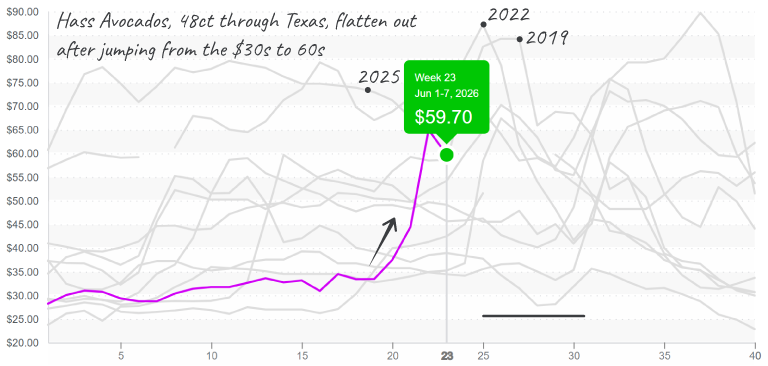
Increasing import supply provides temporary relief for elevated Hass avocado prices. Average prices are down 8 percent from the previous week but remain above average for week #23. Lasting relief may arrive sooner than expected. Mexican growers are accelerating the start of the Loca season, helping bridge the gap before the official end of the Marceña crop.
Hass Avocado prices relax after a steep incline
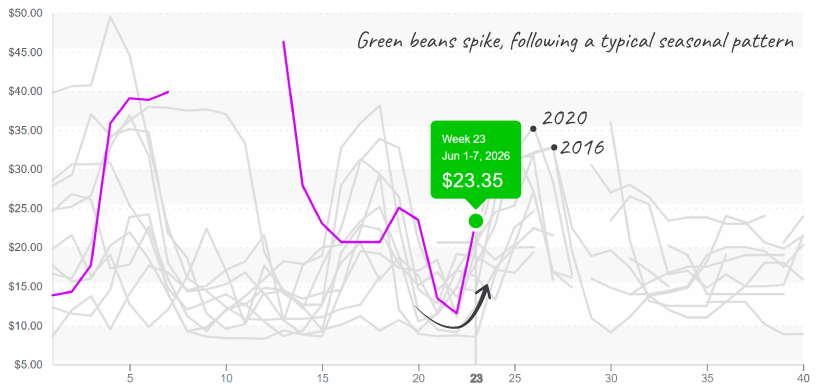
Florida green bean production dissipates, and Mexican volume lags, leaving a sizeable supply gap as growers in South Georgia work to fill it. No stranger to a little volatility, bean buyers are likely well prepared for this kind of seasonal market turbulence. However, if Mexican supply remains low, prices may outpace seasonal trends.
Beans rebound from reaching the floor, following seasonal trends
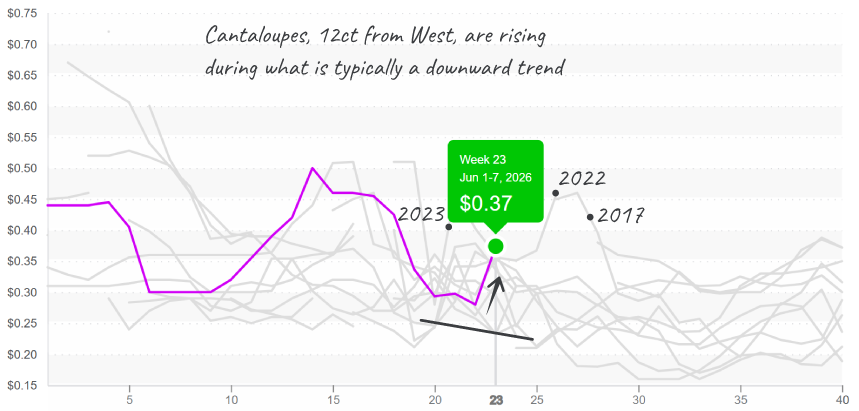
Up 25 percent from the previous week, cantaloupe prices reached their second-highest week #23 level of the past decade. Unseasonably hot weather in Arizona is increasing disease and insect pressure, reducing yields and accelerating the end of the growing season. Growers in California won’t be ready for at least two more weeks, prompting a sizeable production gap. The status quo could persist through June.
Cantaloupe prices begin to rise
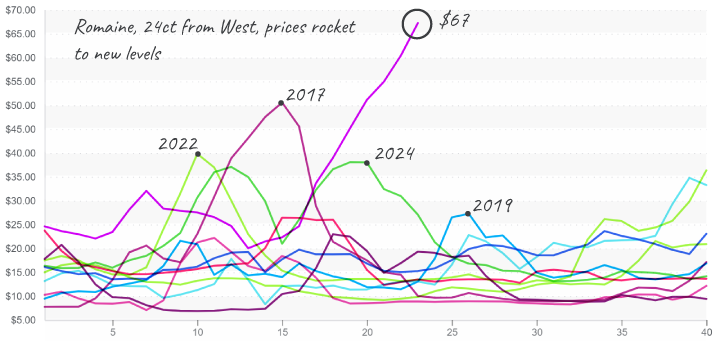
Up 10 percent from the previous week, romaine prices reached a new all-time high for week #23. Similar weather challenges continue to pressure Western lettuce production, constraining yields and supporting elevated prices. The supply situation and high prices are forecast to linger for three more weeks.
Romaine prices are testing new highs
Special editor’s note: Mark Campbell will be part of this week’s Blueprints online content and newsletters as the featured Weekend Interview! Be sure to check out the preview here!
ProduceIQ Index – The ProduceIQ Index is the fresh produce industry’s only shipping point price index. It represents the industry-wide price per pound at the location of packing for domestic produce and at the port of U.S. entry for imported produce.
ProduceIQ uses 40 top commodities to represent the industry. The Index weights each commodity dynamically, by season, as a function of the weekly 5-year rolling average Sales. Sales are calculated using USDA Agricultural Marketing Service data on movement and prices. The Index serves as a fair benchmark for industry price performance.

News you need.
Join Blue Book today!
Get access to all the news and analysis you need to make the right decision --- delivered to your inbox.






Subscribe to our newsletter
© 2026 Blue Book Services. All Rights Reserved

