

















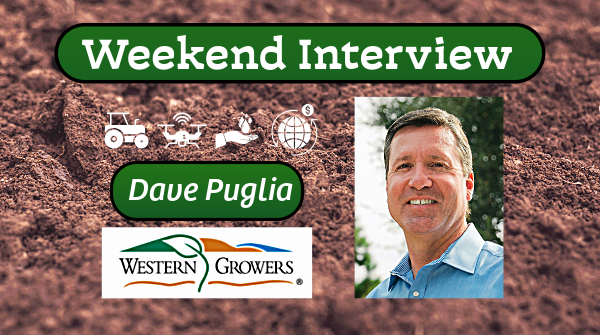
Dave Puglia, Western Growers Association
Economics always wins, whether it's harvest robots, the 60-percent import question, or blueberries from Peru.
Krailis, afif/Adobe Stock
In this article
Dave Puglia didn’t want the job. When Irvine, CA-based Western Growers Association (WGA) BB #:144734 first came calling, the Sacramento native and former campaign spokesman said no.
He changed his mind once he saw how Western Growers was built. He spent his first eight years at WGA lobbying in Sacramento, then moved south to headquarters in Irvine, which he admits is a social faux pas where he grew up. Today he runs the association as president and CEO, in the year it marks its 100th anniversary.
Before agriculture, Puglia worked press operations on statewide campaigns and ran the press office for California’s Attorney General in the 1990s. It shows. He talks about policy the way a campaign manager talks about a race: where are we, where do we need to be, and can we actually get there?
He needs those instincts. California is the world’s fourth-largest economy, and no single industry dominates the political landscape. Agriculture and oil are the only two industries left standing from statehood in 1850, and both now compete for attention with every sector that came after.
Puglia contrasts that with Iowa, where farming drives the economy. Run an ag association there, he says, and “I don’t really have to introduce myself to any single legislator.” In California, where most of its 40 million residents live in cities, it’s harder. Even in Fresno, most people have no connection to agriculture.
What I had to unlearn was my opinion of trade associations.
You ran campaigns and a press office before working in agriculture. What did that teach you about running a trade association, and what did you have to unlearn?
I only say this semi-facetiously, but it taught me how to take body blows, day after day. Being chief spokesperson for a candidate for statewide office in California is like running a national campaign in a midsize country.
And working on the Republican side, I didn’t get a lot of friendly interviews. You learn to take the hit and bounce right back. I didn’t know it at the time, but that probably served me well working for a bunch of hard-nosed farmers.
What I had to unlearn was my opinion of trade associations. I said no to Western Growers the first time they approached me.
I’d seen associations that didn’t have the resources to punch hard and keep punching, and boards of smart people who couldn’t make big decisions quickly. If I’m going to get into a fight, I want real impact. I don’t want to just perform.
Western Growers is built differently. Our board is almost entirely owners and CEOs who aren’t afraid to make big, bold decisions and stick with them when things get tough.
If lawmakers are unwilling to do the obvious thing, what’s the workaround?
Western Growers celebrates its 100th anniversary this year. What’s one thing you’re working on this year that will impact members in 50 or 100 years?
The better question might be what isn’t on the docket.
One common thread is labor. Alongside other ag associations, we’ll keep moving that dirt and see if we can find the pony. That’s our job as advocates.
Congress hasn’t delivered a durable solution to agriculture’s labor shortage in over 20 years. If lawmakers are unwilling to do the obvious thing, what’s the workaround?
Technology. We’ve spent an incredible amount of time and money building an ecosystem in specialty crops that welcomes ag tech entrepreneurs and investors and gets the big equipment manufacturers to engage our industry. Automation is a big chunk of it, aimed at the problems only human labor can solve today.
It’s one of the most exciting initiatives we’ve launched in our 100-year history, and I hope it doesn’t take another hundred years.
Water supply in the West is the other challenge where we can’t seem to reach a positive outcome. With labor, there is a workaround. Water is a little different.
I can’t tell you we’re on the right track with stone fruit yet. That will take more time.
With WGA’s set goal of automating half of harvest by 2031, how close are you, and which crop will surprise people?
On harvest itself, we haven’t moved very far. Maybe we characterized the goal a little too narrowly.
Where we have seen serious commercial scaling is in other labor-intensive work: weeding and thinning with laser weeders and fully autonomous mechanical weeders, and robotic sprayers using precision technology to apply much less material.
I won’t say we’ve cracked the code, but growers who don’t have enough labor for those tasks are getting economically viable options.
Harvest is a different animal, and we knew that when we set the goal. Harvest automation was really my former colleague Hank Giclas’s vision, going back to 2008 or so. From the very beginning, people in ag tech told us the hardest crops to automate for harvest would be stone fruit, berries, and leafy greens.
I can’t tell you we’re on the right track with stone fruit yet. That will take more time. But with berries, and especially leafy greens, there are some really interesting robotics solutions in prototype.
There’s one at Reservoir Farms in Salinas, which we’re invested in. Even as a layperson, you can watch it in action and tell they’ve got this figured out. They still need to solve for speed and cost to the grower.
I’m probably looking at this through rose-colored lenses. I kind of have to be optimistic to stay in this work. But I think we’re looking at a hockey-stick trajectory on harvest automation. There are no guarantees, but I feel better about it today than I did a few years ago.
The berries I ate in Peru were a 10 out of 10. These were a 9.8.
Agriculture Secretary Brooke Rollins says food security is national security. Yet we import about 60 percent of our fruit. Is that a vulnerability, or just how a modern supply chain works?
Secretary Rollins is right, but we need a deeper conversation about how we got here. About 60 percent of our fruit and 40 percent of our vegetables now come from Mexico, and production moved for a reason.
Some of it is seasonality. Peru has become a serious player partly because it’s counter-seasonal. But the majority of the motivation is economic, and a big driver of the economics is public policy, especially what it costs to employ people in California.
A few years ago I led a delegation of our board to Peru. We toured a blueberry operation in the middle of harvest, eating them off the bushes like crazy because they were so good, then watched them get packed into trays bound for the United States under a name everybody knows.
It’s one of our members. Forty-eight hours later I fly into LAX, get home, and my wife and a neighbor are having wine and charcuterie. Right there is one of those trays. The berries I ate in Peru were a 10 out of 10. These were a 9.8. They had lost almost nothing in freshness or flavor.
Between genetic innovation and transportation efficiencies, California doesn’t necessarily have the inside track on every specialty crop forevermore. We can’t take that for granted.
Economics always wins.
Many of our members now grow in the United States and in Mexico, Central or South America. When legislators propose a bill to regulate something in our industry, I tell them: as a standalone matter, I can defend your proposal.
There’s logic to it. But you can’t remove it from 20 or 30 years of mandates already on the backs of California farmers, or from the imbalance between them and their competitors in Mexico.
Economics always wins. If your bill increases the cost of producing a box of anything in California and there’s no offset someplace else, all you’re doing is making sure the laws of economics work their magic even more.
And the buyers aren’t you and me. They’re the big grocery chains. If they can find a box of broccoli in Mexico that’s 15 cents less than the same broccoli coming out of California, they’ll buy it out of Mexico. That’s economics, too.
Will there be more or fewer farmers in California in 10 years? What size farm survives what’s coming?
Even with my natural optimism, I can’t find my way to optimism here. California will continue to lose farms and see consolidation. Cost structures are too difficult for smaller producers, so they find the loving arms of a larger competitor to buy them out.
Beyond that, we’re looking at potentially a million acres or more of highly productive San Joaquin Valley farmland taken out of production completely in the next 10 to 15 years.
The cause isn’t development. It’s water. Between restrictions on surface water from Northern California and new regulatory limits on groundwater, you can’t farm. It makes it kind of hard to grow food.
I do have members planting agave in very dry parts of the valley with an eye toward a California agave spirit.
What does that land become? I don’t know. I do have members planting agave in very dry parts of the valley with an eye toward a California agave spirit. They can’t call it tequila. That gives me a reason to be a little hopeful, but I doubt we can plant a million acres of agave.
California has created a regulatory morass, and not just for agriculture. There’s a reason the film and television industry is leaving. Taxes, labor, energy: just about everything here costs more than anyplace else in the country.
Sometimes Hawaii has higher gasoline prices. So we will lose many more farmers, and the ones who remain will be, of necessity, even bigger. That’s the only way to absorb the regulatory cost California requires.
What trend are you more optimistic about than most of your members?
There are two. Some of our members see them, but many still need some convincing. The first is technology, especially a suite of technologies working together.
Genetics and seed breeding for traits that make a crop easier for a robot to harvest. Science that addresses pest and disease pressure with fewer chemical inputs, lower costs, and better outcomes for yield and soil health.
When technology and research come together with a profit motive that attracts capital and innovators, that gives me a sense of long-term economic sustainability for American growers.
The second I’m a little less certain about, because it’s newer and a little more nuanced at times. It’s the Make America Healthy Again (MAHA) movement. It’s a loosely knit band of people who don’t always share the same objectives but set that aside.
This country is finally having a serious discussion about our food. Where does it come from? How is it grown? Why do our cereal boxes have ingredient lists three times as long as the same cereal in the European Union?
That discussion is showing staying power and political relevance for both parties. There are elements where we have to say, “Careful, folks, slow down. Not all chemicals are bad.” But would anybody today buy a tub of margarine and put it on the table for their kids?
For fresh produce, this is a very positive moment.

News you need.
Join Blue Book today!
Get access to all the news and analysis you need to make the right decision --- delivered to your inbox.





Subscribe to our newsletter
© 2026 Blue Book Services. All Rights Reserved

