

















Detroit in the Spotlight: Winning the perishables race
The Motor City's dual markets continue to serve up the freshest fruits and vegetables with speed and agility.
Deificusart/Wirestock Creators, Alexander Raths/Adobe Stock
In this article

Automobiles and farmers markets usually don’t have anything to do with one another, except when they do. Both got their start in Detroit, and both have flourished over the years.
The Eastern Market, a huge farmers market in its current location since the 1890s (but started elsewhere in Detroit in 1841), is the oldest such market in the country. It hosts about 225 vendors on a busy day and recently added a new “shed,” housing multiple companies.
The Detroit Produce Terminal, the B2B market and home to seven primary “houses,” opened in 1929—the same year the automobile industry was founded in Detroit—and now spans 300,000 square feet, covering over 20 acres.
Channeling Growth, Incrementally
Growth at the terminal market is largely tied to systems, productivity, expanded offerings, and sustainability.
For example, last year the wholesalers at the Detroit Produce Terminal began donating excess produce to emergency food systems as part of a rescue program.
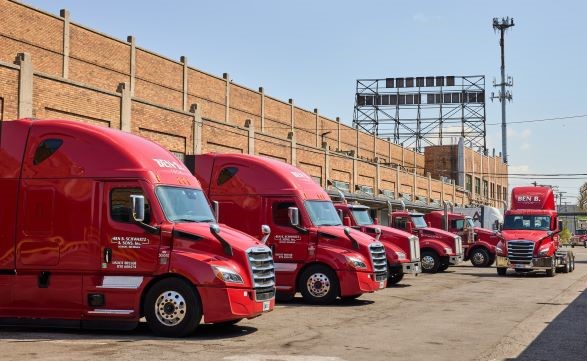
Ben B. Schwartz & Sons, Inc. BB #:104793, the largest distributor at the terminal, has since donated over 3.5 million pounds of food to Southeast Michigan organizations according to Jordan Grainger, vice president of sales and business development,
Ben B. Schwartz also is focused on its own growth and is actively expanding its distribution network throughout the United States and Canada. The Midwest will always be its core market, Grainger notes, with Ben B. looking to increase its presence in other key markets such as Chicago.
There are, of course, plenty of impediments, especially economic volatility, including tariffs and high fuel costs, as well as ongoing labor issues and everyone’s favorite wild card—weather.
“Fresh produce is a resilient industry because high-quality fruits and vegetables will always be in demand,” points out Grainger. “Price swings are always a concern, but we have a vast grower network in place to help us offset costs that would otherwise trickle downstream to our customers.”
Grainger adds that people across the supply chain have joined forces solve such problems, seeking ways to work better together.
Tom Sheena, sales manager of Thomas Produce, Inc. BB #:282440, echoes similar thoughts about the Eastern Market. “It’s a very cool community,” he says.
“People work together; it’s always been the case.” He mentions the company has many long-term relationships, likening some to family.
Sheena says this is possible due to several enduring factors: “We stay at a fair rate and pride ourselves on honesty, integrity, and excellent character.”
Sam Randazzo, Jr., senior buyer for Joe Randazzo’s Fruit & Vegetable, Inc. BB #:104780, agrees. “The produce business is the biggest relationship business,” he says. “If you play it fair, nine times out of ten, you’ll get what you need.”
“If you play it fair, nine times out of ten, you’ll get what you need.”
Going Above and Beyond
Even with a population of more than 3.5 million in Detroit’s metro area, the personal touch counts.
Whether operators are based at the Detroit Produce Terminal, the Eastern Market, or areas surrounding these locations, relationships are key.
These strong, longstanding connections among suppliers, distributors, and their customers keep business moving forward in good times and challenging ones.
“Our customers understand that we consider ourselves a partner to their business instead of a vendor, so we work with them the best we can to keep costs on track,” observes Grainger.
He cites multiple ways to mitigate higher costs such as sourcing from closer or seasonal growers, bundling orders, optimizing delivery routes, and providing discounts when possible.
Ben B. has also expanded value-added services like repacking and bagging, as well as white-labeling for customers to repack using their own brands and labels.
Promoting local, whenever possible, is another cornerstone of the business.
“Detroit in particular has a very strong community mentality,” Grainger explains. “Customers are loyal to family-run businesses and neighborhood stores, so it’s important for us to offer local-only produce bundles.”
“Detroit in particular has a very strong community mentality.”
Others stress the importance of finding and maintaining balance, however precarious.
Dominic Riggio, president of Riggio Distribution Company BB #:104709, a receiver at the Detroit Produce Terminal, admits selling perishables is a very tricky business.
“All parts of the industry are constantly balancing quality, cost, supply, demand, and many other things. Riggio Distribution is a partner to all of our customers and suppliers as we all manage the constant challenges of our industry.”
Randazzo concurs and puts it this way: “Trying to find the sweet spot between price and volume is a challenge—along with not being able to use the past for benchmarks because of the unknowns.”
His business is both a wholesaler and a retailer with four stores, operating from a 16-door warehouse opened two years ago.
Randazzo describes it as their own terminal market, located 15 minutes away from the Detroit market. The company has a fleet of 20 trucks and counting.
Market Highlights, Trends, and Movers
As far as what’s trending at the markets, there are seasonal faves, the usual summer fare, and a few surprises.
Randazzo mentions seeded watermelon, outpacing seedless watermelon four-to-one, and says cherimoya is doing well too.
Also known as custard apples, the fruit looks like green-skinned dinosaur eggs with white flesh and black seeds. Randazzo saw it trending on social media, decided to give it a try, and has been pleased with the results.
Riggio is enthused about with the return of seasonal fruits and vegetables. “Local is seasonal and everyone always looks forward to the product coming into the market.”

For Thomas Produce, cherries and cabbages are current bright spots, but they’re a fraction of what’s available every day.
The company’s basic order sheets have 350 items but this can climb to more than 475 items, and Sheena says he’ll bring in whatever customers want.
Grainger says Ben B’s demand is steady and mirrors previous years, with a few upticks in root vegetables like carrots and beets, and what he considers highly “versatile” items such as cauliflower.
Final Thoughts
All told, the fresh produce trade is in good stead, with plenty of seasonal fruits and vegetables from around the state and shipments from across the Midwest, country, and both Canada and Latin America as needed to augment supply.
Whether they’re dealing in local produce or otherwise, Detroit’s wholesalers and distributors are busy and enjoying the summer months.

News you need.
Join Blue Book today!
Get access to all the news and analysis you need to make the right decision --- delivered to your inbox.





Subscribe to our newsletter
© 2026 Blue Book Services. All Rights Reserved

