


















Produce opportunities during foodservice’s slow recovery
The pandemic greatly harmed the foodservice industry, and it hasn’t recovered to pre-pandemic levels. David Henkes, a principal at Technomic, presented data from a study at the IFPA BB...
The pandemic greatly harmed the foodservice industry, and it hasn’t recovered to pre-pandemic levels.
David Henkes, a principal at Technomic, presented data from a study at the IFPA BB #:378962 Foodservice Conference July 25, that shows foodservice segment growth in 2024 is about 90 percent of what it was in 2019. And it’s not projected to reach 2019 levels until 2028.

This decade-long setback isn’t solely due to pandemic restrictions on all levels of foodservice, Henkes said. The data shows that rising costs and concerns about shelf-life are the two biggest factors that operators say hinder them in making a full recovery.
Labor is also a major factor, he said, but that’s nothing new: “We had a survey in 1970 [about foodservice concerns], and the biggest concern was labor.”
When foodservice is broken down into segments, the strongest is foodservice in retail, followed by restaurants and bars. The segment most damaged and slowest to return is travel and leisure.
“Personal travel is way up, but business travel has not recovered,” Henkes said. “On the increase is ‘bleisure,’ the mixing of the two. The events business is booming. People visit offices less because people aren’t in their offices as much, but they go to events.”
Event catering can be a big opportunity for fresh produce to make gains, he said.
Other trends are positive for fresh produce growth in foodservice. For example, Henkes said the beverage category is growing, and many drinks include fresh fruit.
Another trend is the growth of limited-time-offers, which he said are perfect for fresh fruits and vegetables since their volume has more volatility, and it also plays into seasonality.
While health and wellness is a growing trend for diners, indulgence remains a prime motivation.
“Consumers will pay for things they can’t do at home, so menus have to be innovative, [and operators] have to develop and train staff to deliver it,” Henkes said.
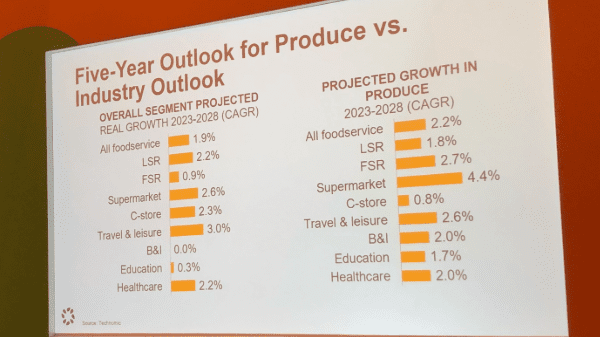
Looking five years in the future, Henkes said produce is projected to grow more in segments such as supermarket foodservice, full-serve restaurants, and travel and leisure.
He also noted opportunities in education and health care, where health and wellness have more importance than indulgence.
Image sources are either licensed or customer-provided.

News you need.
Join Blue Book today!
Get access to all the news and analysis you need to make the right decision --- delivered to your inbox.








Subscribe to our newsletter
© 2026 Blue Book Services. All Rights Reserved

