

















ProduceIQ: Dry veg transitioning north; farmers dream of a free Cuba
Floridian farmers lamenting the loss of the best farmland to million-dollar homes may have a new opportunity in future years.

Image courtesy of ProduceIQ.
Floridian farmers lamenting the loss of the best farmland to million-dollar homes may have a new opportunity in future years. Florida’s reputation as the winter vegetable garden is increasingly difficult to maintain as costs, energy, freight, labor and land, continue to rise.
Some think the long-term solution for affordable produce is 90 miles to the South.
President Trump signed executive orders to expand U.S. sanctions against the Cuban regime and has been increasingly direct, recently saying the U.S. could, “do something with Cuba very soon” and even floating the idea of a, “friendly takeover.”
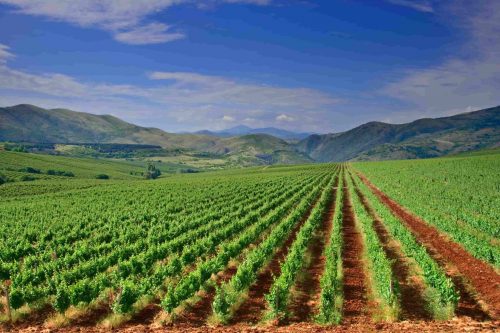
Cuba has an estimated 6–7 million acres of arable farmland, much of it underutilized, with a variety of micro-climates ideal for winter vegetable production. And it’s not a multi-day boat ride like the Dominican Republic, Honduras, or Guatemala. It’s close enough that, pre-Castro, there were regular ferry routes moving people back and forth daily.
Back on U.S. soil, spring transition is challenging but within the range of normal. The transition northward is always a bit messy. Crops that require fewer growing days, such as squash and cucumbers, begin to harvest first while the category leader, peppers, is slower to make the transition. Logistics become more important than ever for mixer loads with multiple picks over Florida and Georgia.
ProduceIQ Index: $1.37/pound, down -4.2 percent over prior week
Week #18 ending May 1
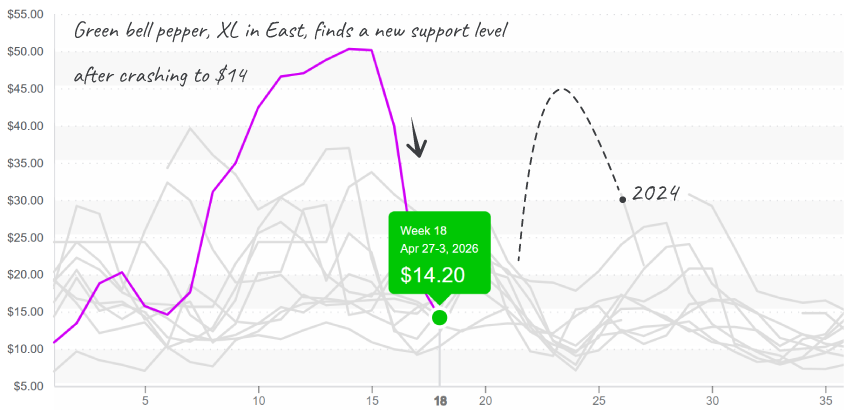
The harder they rise, the harder they fall. Bell peppers did a nosedive after two full months at record-high levels. Falling from $50 to $14 makes it difficult to find a stable floor; XL green peppers are bouncing back to $18-20. Georgia is still 7-10 days out and Florida is winding down with many offgrades and suntan available.
Peppers return to earth and should stabilize before Georgia begins in a week
Cucumbers are holding a good market, for now. Georgia is just about ready to start picking. Florida is winding down and Mexican production is minimal. Supers are $18-20, selects $14-16. Given how expensive the rest of the salad set is right now, both leaf and tomatoes, cucumbers may be a more affordable way to fill up a salad.
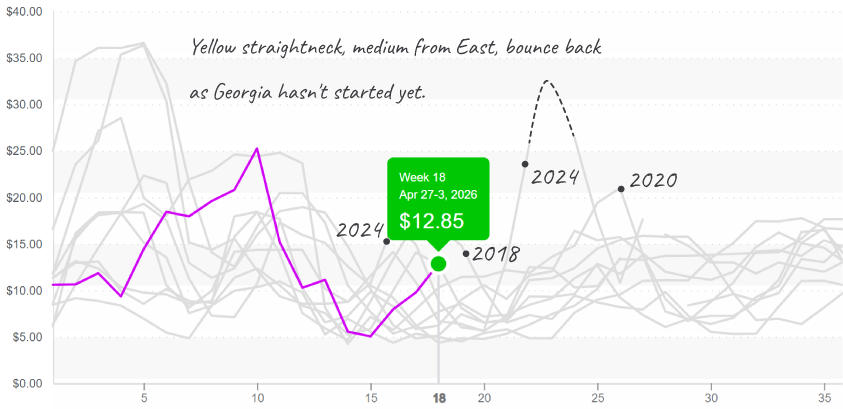
Squash markets are still holding. Zucchini is $16–18, and yellow squash $18–20. But the window is closing. Georgia is late, lighter planted, and currently dealing with some rain. Once South Georgia comes online in the next 7–10 days, prices are expected to move lower.
Yellow squash prices in East firm up since Georgia picking is delayed
Beans remain tight, holding for the moment. Supply remains limited in the South, but that situation won’t last. Georgia beans have begun in a light way, and other regions, such as the Carolinas, will begin to open shortly. Buyers should expect additional price relief over the next few weeks.
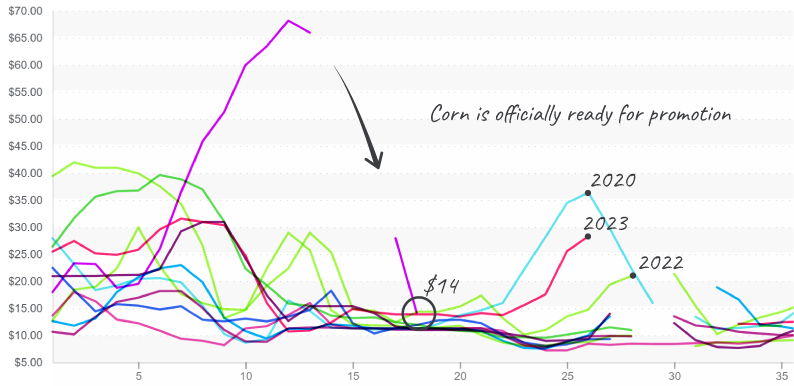
After a rough and scarce winter, corn is once again, officially ready for promotion. Though a $14 market sounds really cheap after the past few months, the market will likely move lower as shippers face overlapping growing regions. Volume remains in Florida and Georgia corn has started. It’s time for retailers to promote the arrival of summer with discounted corn.
Corn prices plummet from over $60 to $14 and good deals may be negotiated
The ProduceIQ Index is the fresh produce industry’s only shipping point price index. It represents the industry-wide price per pound at the location of packing for domestic produce and at the port of U.S. entry for imported produce.
ProduceIQ uses 40 top commodities to represent the industry. The Index weights each commodity dynamically, by season, as a function of the weekly 5-year rolling average Sales. Sales are calculated using USDA Agricultural Marketing Service data on movement and prices. The Index serves as a fair benchmark for industry price performance.
News you need.
Join Blue Book today!
Get access to all the news and analysis you need to make the right decision --- delivered to your inbox.







Subscribe to our newsletter
© 2026 Blue Book Services. All Rights Reserved

