

















ProduceIQ: Fall transition looms over lettuce markets
Hurricane Eric may have remained at sea, but late-season pests in Salinas, CA, and heavy rains in Mexico, are causing their own turbulence.

Images courtesy ProduceIQ
Back-to-school collides with peak hurricane season and fall transition. Hurricane Eric may have remained at sea, but late-season pests in Salinas, CA, heavy rains in Mexico, and tight supplies across Central America are causing their own kind of turbulence.
Overall, prices are rising, and buyers and shippers are preparing for a bumpy end to the summer growing season.
ProduceIQ Index: $1.09/pound, +4.8 percent over prior week
Week #33, ending Aug 15th
Blue Book has teamed with ProduceIQ BB #:368175 to bring the ProduceIQ Index to its readers. The index provides a produce industry price benchmark using 40 top commodities to provide data for decision making.
Hurricane Eric faced nature’s most epic obstacle course: Saharan Dust, wind shear, and thousands of miles of open ocean to reach Category 5 status over the weekend. Fortunately, the Bermuda High, an area of high pressure over the Atlantic, guided the storm safely away from land, avoiding a direct hit.
As a result, the massive storm won’t affect produce markets this week. Still, Eric serves as a stark reminder that we are in the heart of hurricane season and anything can happen.
The National Hurricane Center is monitoring two additional areas of interest in the Atlantic. One near the Cabo Verde islands is moving westward and should be watched closely as it develops over the next seven days.
Back on land, late-season pressure in Salinas is reducing yields and quality, with lighter weights, seeder, mildew, and insect damage all threatening supply. Iceberg prices dipped briefly but are expected to firm up as supplies tighten through September.
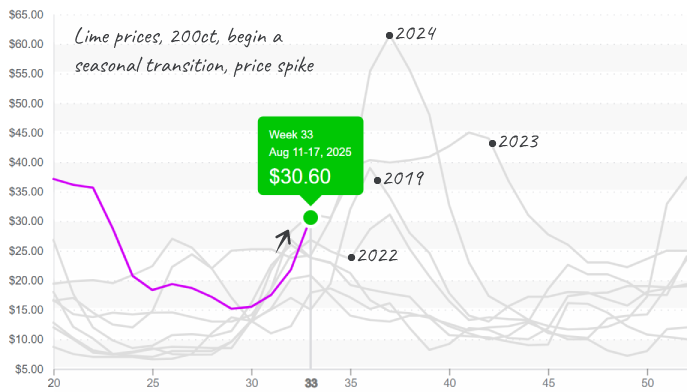
Heavy rain in Central Mexico is amplifying lime supply problems. Average prices are up +36 percent from the previous week to $30, marking the second-highest average for week #33 in the past decade. Smaller-sized fruit is more available, but overall supply is expected to remain limited through early September.
Lime’s seasonal rise begins with gusto
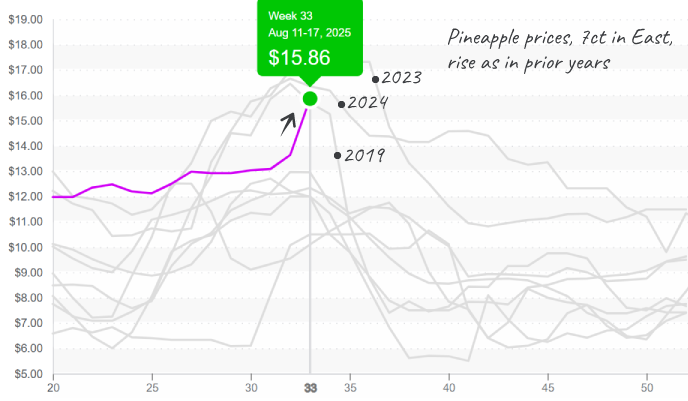
Up +21 percent over the previous week, pineapple prices continue their nearly vertical trajectory. Historically low volume from Central American growers is driving record price increases for week #33. Typically, pineapple prices reach their annual peak between weeks #30 and #35 before gradually declining into early December. However, 2025’s average prices have been quite unusual and may only roughly follow usual patterns due to significantly lower-than-normal supply.
Pineapple prices finally rise as in prior years
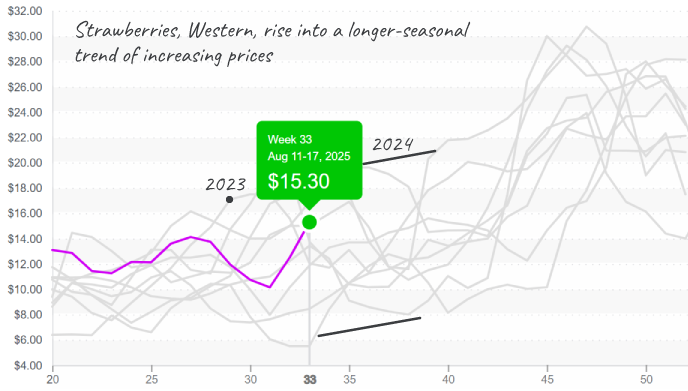
Average strawberry prices rise sharply, increasing by +26 percent from the previous week. Strong demand, declining production in the Salinas/Watsonville areas, and heat-related quality issues are all contributing to tightening supplies. Growers in Santa Maria, CA, are working to cover the gap, but supply will likely feel stretched until Oxnard growers come online in September.
Strawberry prices begin their longer-cyclical price increases, which peak in December
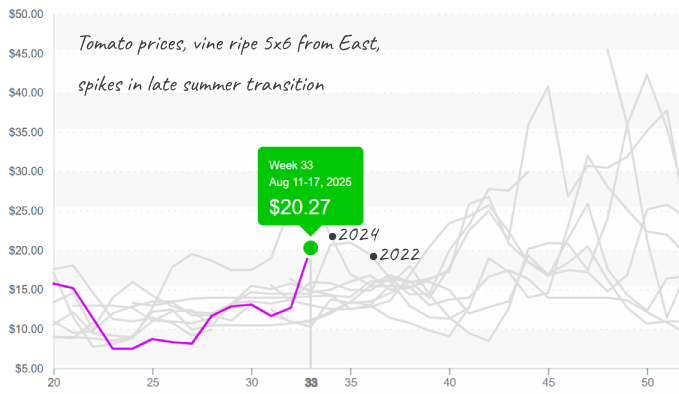
Average round tomato prices have risen sharply compared to the previous week due to unusually low supply from growers in Tennessee, Virginia, and North Carolina. Persistent, heavy rain and high heat have reduced shelf life and shortened yields. Expect prices to remain high until weather conditions improve and supply rebounds.
Tomato prices spike before production returns to Georgia
ProduceIQ saves you time and provides valuable information to increase your profits.
The ProduceIQ Index is the fresh produce industry’s only shipping point price index. It represents the industry-wide price per pound at the location of packing for domestic produce and at the port of U.S. entry for imported produce.
ProduceIQ uses 40 top commodities to represent the industry. The Index weights each commodity dynamically, by season, as a function of the weekly 5-year rolling average Sales. Sales are calculated using the USDA’s Agricultural Marketing Service for movement and price data. The Index serves as a fair benchmark for industry price performance.

News you need.
Join Blue Book today!
Get access to all the news and analysis you need to make the right decision --- delivered to your inbox.






Subscribe to our newsletter
© 2026 Blue Book Services. All Rights Reserved

