


















DAT: Price pressures build as available capacity tightens
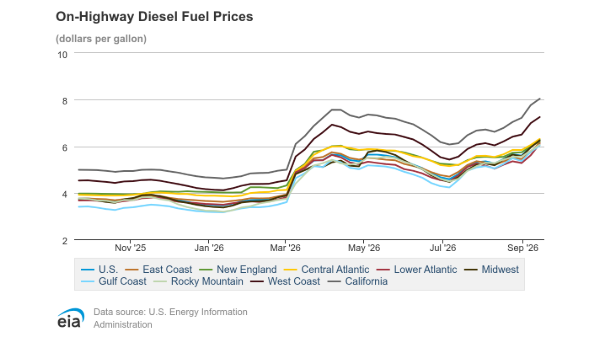
Diesel prices surge to $5.375 per gallon—the highest weekly national average since late 2022—which tightened capacity the week of March 22-28

With diesel prices surging to $5.375 per gallon—the highest weekly national average since late 2022—the cost shock appeared to tighten capacity during the week of March 22-28: truck posts fell across all three equipment types, with dry van, reefer, and flatbed each reaching their lowest Week 13 truck-post counts in at least 10 years of DAT data. Fewer trucks helped push rates higher across the board.
Freight trends from DAT One and DAT iQ
Spot market data for March 22-28, 2026 (Week 13)
▲ Dry van: $2.34 per mile, up 6 cents week over week
▲ Refrigerated: $2.75 per mile, up 6 cents
▲ Flatbed: $2.80 per mile, up 10 cents
Total load posts rose slightly to 3.99 million last week, suggesting demand remained steady as available capacity contracted.
Van: Truck posts hit 10-year low for Week 13
▲ Van loads: 1,543,669, up 1% week over week
▼ Van equipment: 145,987, down 4%
▲ Linehaul rate: $1.97 per mile, up 5 cents
▲ Load-to-truck ratio: 10.6, up from 10.0
Reefer: Capacity loosened slightly as produce season approaches
▼ Reefer loads: 741,053, down 4% week over week
▲ Reefer equipment: 37,466, up 1%
▲ Linehaul rate: $2.38 per mile, up 6 cents
▼ Load-to-truck ratio: 19.8, down from 20.7
Flatbed: Equipment at 10-year low as construction demand builds
▲ Flatbed loads: 1,709,119, up 2% week over week
▼ Flatbed equipment: 20,407, down 2%
▲ Linehaul rate: $2.44 per mile, up 10 cents
▲ Load-to-truck ratio: 83.8, up from 80.4
Market analysis from Dean Croke, Industry Analyst, DAT Freight & Analytics
Fuel is up $1.31 per gallon over the past three weeks, but spot linehaul rates are holding steady. The gap between rising fuel costs and flat spot rates is worth watching.
Truckers are responding to fuel prices by cutting deadhead miles, looking for lighter loads, and slowing down. At current diesel prices, slowing from 75 to 65 mph saves roughly 8 to 9 cents per mile in fuel—the equivalent of a significant per-mile pay raise without hauling a single extra load.
Carriers are also sitting on the sidelines or declining unprofitable loads, which for brokers increases the urgency of having deep carrier relationships rather than relying on transactional capacity.
The Manufacturing PMI jumped into expansionary territory this year, and New Orders—a key indicator for freight volumes—was a big component. If PMI growth continues, it would mean a fuel shock is hitting the market just as freight volumes are recovering, a situation that could keep rates elevated even if fuel moderates.
The Dallas Fed said Texas factory activity continued to rise in March, but at a slower pace than the previous month, according to business executives responding to the Texas Manufacturing Outlook Survey. The production index, a measure of state manufacturing conditions, fell six points to 6.8, a reading suggestive of a below-average pace of output expansion.
About DAT Freight & Analytics
DAT Freight & Analytics operates DAT One, North America’s largest truckload freight marketplace; DAT iQ, the industry’s leading freight data analytics service; the Convoy Platform automated freight-matching service; Trucker Tools, the leader in load visibility; and Outgo, the financial services platform for truckers. Check out the latest DAT iQ Market Update every Tuesday or on demand: https://www.youtube.com/DATLoadBoards.
Load and truck posts refer to the number of posts on the DAT One marketplace during Week 13 (March 22-28). Load volume refers to the number of loads moved. Rates are aggregated from invoice data submitted to DAT iQ. dat.com

News you need.
Join Blue Book today!
Get access to all the news and analysis you need to make the right decision --- delivered to your inbox.




Subscribe to our newsletter
© 2026 Blue Book Services. All Rights Reserved

