


















Cyclospora outbreak investigation zeroes in on produce
IFPA says social media and public health officials are rushing to place blame instead of identifying a source using evidence and data.
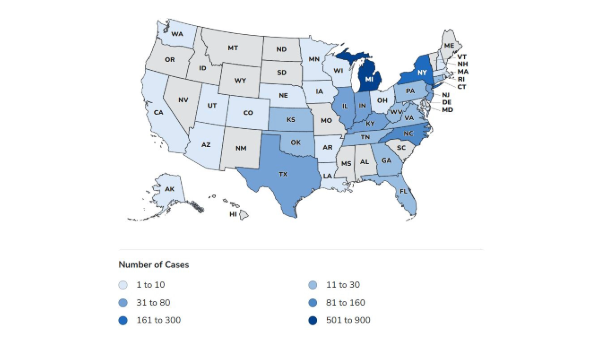
Courtesy CDC
The Centers for Disease Control and Prevention (CDC) is investigating a Cyclospora outbreak with 1,645 confirmed cases in 34 states as of July 14, 2026, including 141 hospitalizations and no deaths.
CDC has not identified a source and is working with state and federal agencies.
Cyclosporiasis is a gastrointestinal illness caused by the microscopic parasite Cyclospora. People can become infected by consuming food or water contaminated with the parasite.
Even though no source has been found, social media and mainstream media have focused on fresh produce and lettuce specifically.
Michigan has the most confirmed cases, and the Michigan Department of Health and Human Services said in a statement that past cyclosporiasis outbreaks in the U.S. and Canada have been linked to bagged salad mixes and kits, fresh cilantro, fresh basil, raspberries, snow peas and green onions.
IFPA Statement on the 2026 Cyclospora Outbreak
Max Teplitski, chief science officer for the International Fresh Produce Association BB #:378962, said in a statement that the outbreak is on track to be the largest Cyclospora outbreak in U.S. history.
“Our central concern is this: the response we are seeing will likely not slow this outbreak down or stop people from getting sick, nor is it intended to identify the root cause of the outbreak to prevent future outbreaks.
“Here is why: social media and public health officials are rushing to place blame instead of identifying a source. Assigning blame is not the same as identifying a source. Without evidence, like a contaminated product test, there is no way for anyone, including industry partners, to know how this happened and prevent it from happening again. A contaminated product has not been identified, even though samples were collected at least a week ago. Everything pointing to produce is based on recollections of patients, and even those recollections – based on what we hear – explain at most, only half of the current cases. I am concerned that a statement released by the Michigan Department of Health and Human Services defies reputable science 1 2 3 and states that recreational waters are not a ‘recognized risk factor.’
“We need to be candid about the limits of the data being used here. A parasite with a notoriously complex life cycle, Cyclospora can be hard to detect in the environment, and some of the methods for its detection have performed inconsistently 4. Genomic tools (such as those available for bacterial pathogens) are not as well developed for Cyclospora. Responses from questionnaires (also known as epidemiological surveys) are a valuable signal, but not the type of the robust evidence needed to restore consumer trust in foods, drinking or recreational waters. Such questionnaires gather what patients recall about what they ate (often many days ago). Results of these surveys were not shared with the industry to support a meaningful investigation into the causes of the outbreak. In an outbreak of this magnitude, we urge partnership between public health officials and the industry.
“Trust of consumers in food, drinking water and its public health systems takes years to build. It can be destroyed with a statement that is not supported by robust data. Naming a product, grower, supplier, distributor, or restaurant without evidence (such a contaminated food sample) undermines such trust and puts thousands of jobs in jeopardy and does nothing to stop an ongoing outbreak or prevent the next one.
“IFPA has long being a champion of end-to-end traceability in the fresh produce industry, and IFPA and our members are on the record against continued delays with the implementation of the Traceability Rule. IFPA has offered technological solutions that will bring the entire supply chain into traceability compliance.
“Further, we repeat our offer to the federal and state agencies for earnest bi-directional sharing of the information that can help bring this outbreak to a meaningful closure. Take us up on this offer!”
IFPA points people to its consumer and media FAQ, which is a live document and will be updated as new information is verified: freshproduce.com/who-we-are/commentary/cyclospora-faqs.
News you need.
Join Blue Book today!
Get access to all the news and analysis you need to make the right decision --- delivered to your inbox.








Subscribe to our newsletter
© 2026 Blue Book Services. All Rights Reserved

