

















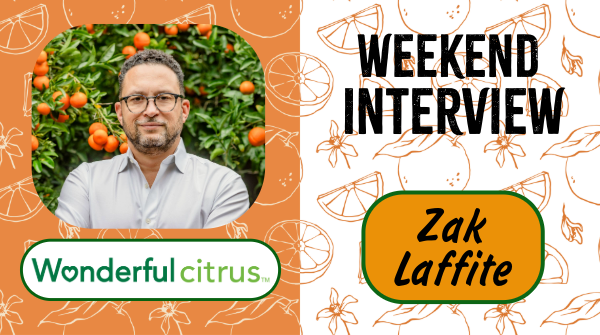
Zak Laffite, Wonderful Citrus Cooperative
If you've enjoyed a tiny, sweet orange or a seedless lemon lately, there's a good chance Zak Laffite and his team had something to do with it.
Anastasiia/Adobe Stock
In this article
As president of Wonderful Citrus Cooperative BB #:115157, Zak Laffite is a pro when it comes to all things citrus. But where did his career begin and how did his early roles prepare him to lead at one of the country’s most recognizable companies?
We chat with Zak about his past, the present, and the future of citrus, as well as other pursuits.
Q: Tell us about your background and education.
I’m originally from Honduras, where my family has been involved in farming for three generations. Agriculture has always been a core part of my background, particularly citrus, so my role at Wonderful Citrus feels like a natural extension to my family’s roots.
I came to the United States for my education, earning my undergraduate degree in pomology from Cornell University, a specialized field focused on fruit science and cultivation. After completing my studies, I returned to Honduras and spent several years with Dole.
Later, I came back to the United States to pursue my MBA at Tulane University and eventually joined The Wonderful Company.
I’ve now been with The Wonderful Company—more specifically, Wonderful Citrus—for nearly 22 years. During that time, the company has evolved tremendously, and it’s never felt like working for just one organization.
Instead, it’s been like experiencing multiple stages of growth and transformation within the same company, each bringing new energy, opportunities, and challenges that have kept me motivated and engaged throughout my career.
Q: What were your initial career aspirations?
Initially, I wanted to stay involved in the family business, but I knew gaining experience outside it would ultimately make me a stronger leader and contributor.
While pomology didn’t come naturally to me at the outset, I always knew agriculture was where I wanted to build my career and future.
At Dole, I worked as a TQM-ISO 9000 analyst responsible for flowcharting and standardizing banana packinghouse processes.
It wasn’t exactly how I envisioned the start to my career, but the experience was incredibly humbling and ultimately one of the most valuable lessons early on.
My boss at the time gave me advice that has stayed with me throughout my career: “The quickest way to move out of a job you don’t like is to do it better than anyone else while showing me you’re capable of much more.”
The first year after taking the helm from David was a balancing act between asking myself, “What would David do?” versus “What would I do?”
Q: What was it like to take over from David Krause, who held the role for decades and is so well known in the industry? Did he pass along any words of wisdom?
The first year after taking the helm from David was a balancing act between asking myself, “What would David do?” versus “What would I do?”
David built an incredible legacy, where I was his direct report for more than 10 years both as a director and an executive, so stepping into the role came with a deep sense of responsibility and an opportunity to lead in my own way.
One piece of advice he shared is that leadership can be lonely at times—ultimately, there are decisions you have to make on your own. This perspective helped prepare me for the weight and responsibility of the role.
Q: Let’s talk citrus: how many types does Wonderful grow and sell?
Wonderful Citrus is a vertically integrated global citrus enterprise based in Delano, CA, delivering exceptional quality from growing and shipping to packing and marketing for more than 75 years.
Spanning more than 60,000 acres across California, Texas, and Mexico, Wonderful Citrus offers a diverse portfolio of more than 10 varietals including mandarins, minneolas, navels, valencias, cara caras, lemons, seedless lemons, limes, key limes, and grapefruit.
We operate domestically across three primary growing regions in California, including the Central Valley, the Desert Coast, and the Salinas Valley. We’re also a major producer in Texas, primarily focused on grapefruit.
Internationally, we have several large projects in Mexico, mainly focused on limes and seedless lemons. The acreage includes both company-owned operations and partnerships with growers.
As Wonderful Citrus expanded its portfolio, the company pursued a vision of becoming a one-stop citrus shop.
Q: How do you prevent your various brands and products from competing for shelf space?
As Wonderful Citrus expanded its portfolio, the company pursued a vision of becoming a one-stop citrus shop—curating a broad basket of core citrus offerings while delivering each at consistently high quality.
Rather than competing with one another, these products serve distinct consumer needs and usage occasions, complementing each other across the category.
As shoppers continue to look for simple, grab-and-go snack options, packaged citrus, such as Wonderful Halos, is seeing strong momentum. Halos make snacking easy as they’re sweet, seedless, easy-to-peel, perfect for on the go, and require no advance preparation.
They’re available in 2- and 3-pound bags and 5-pound bags and boxes, offering flexibility for a range of needs from daily lunches to fueling sports teams. For consumers seeking organic options, we also offer organic Halos in 2-pound bags at select retailers.
Meanwhile, lemons and limes play a different role in the category, functioning primarily as ingredients and condiments tied to healthier eating trends.
The convenience, versatility, and consistent quality of Wonderful Seedless Lemons have made them a standout in the kitchen and a strong driver of incremental category growth.
We have an entrepreneurial mindset and a constant drive for growth, but every new varietal begins with a clear understanding of consumer demand.
Q: What’s the process for handling something new, like seedless lemons?
At Wonderful Citrus, our approach to bringing something new to market is rooted in both innovation and discipline. We have an entrepreneurial mindset and a constant drive for growth, but every new varietal begins with a clear understanding of consumer demand.
We closely analyze evolving trends and purchasing behavior, particularly as consumers increasingly seek out functional foods that are flavorful, convenient, and aligned with their wellness goals.
Wonderful Seedless Lemons are a great example. They’ve been a true disruptor; their simplicity and uniqueness make them more approachable for everyday use.
Following our expansion into Mexico, we’re now able to support year-round distribution across major retailers including Whole Foods, Walmart, Trader Joe’s, and Kroger, among others.
Consumer education is also a key part in the process. We’ve invested in point-of-sale displays, marketing campaigns, and strategic partnerships to drive awareness and trials, because once consumers experience Wonderful Seedless Lemons, they tend to stick with them.
As a result, they’ve quickly become a game-changer for the lemon category. We’ve seen consumption grow more than 40 percent this past year, only limited by supply constraints, and strong gains in household penetration.
Additionally, Wonderful Seedless Lemons have contributed 100 percent of the growth in the bagged lemon category for the second consecutive year, capturing the attention of heavy lemon users and reinforcing the significant opportunity ahead as we continue to scale availability.
I often compare the global market to a game of musical chairs—there’s always another producing country ready to step in and take market share when conditions shift.
Q: How much of your citrus is exported and to where? Has the world’s geopolitical turmoil affected volume?
Exports can account for as much as 40 percent of volume for certain citrus varieties, though across our overall portfolio the average is closer to 15 percent, including shipments throughout North America.
Our primary international markets are in Asia, with oranges and lemons representing the largest share of exports.
Unfortunately, ongoing geopolitical turmoil has weakened California citrus’ competitive position overseas. Since 2016, for example, orange exports to China and Hong Kong have declined by 78 percent.
Citrus is grown in more than 140 countries worldwide, so I often compare the global market to a game of musical chairs—there’s always another producing country ready to step in and take market share when conditions shift.
Q: In today’s world, what do you consider the weakest link in the citrus supply chain? How can it be improved?
In today’s environment, one of the weakest links in the citrus supply chain is labor availability, along with the rising cost of moving products efficiently from farms to stores.
Ongoing labor shortages, increasing transportation costs, and broader supply chain disruptions continue to create challenges. Strengthening collaboration between growers and retailers will be critical to building a more adaptable and resilient supply chain.
It can be difficult to distinguish solutions for commercial implementation from those that theoretically address an existing need.
Q: Where is AI having an impact across operations? How are you vetting results? Where is it falling short?
We’re passionate about expanding our use of ag-tech and innovative solutions across our vertical integration. However, it can be difficult to distinguish solutions for commercial implementation from those that theoretically address an existing need. Failure rates and company turnover in ag-tech are a challenge.
One of the most visible impacts has been the adoption of autonomous vehicles, drones, and automated systems from the field to packing facilities. Operational processes already look markedly different than they did just a few years ago, reflecting a significant technological shift within the industry.
At the same time, our approach is rooted in continuous improvement. We’re open to leveraging AI and emerging technologies where they add real value so we can remain agile.
Precision grading technology is already helping to transform how we farm—enhancing efficiency, sustainability, and productivity by optimizing resource usage, monitoring crop health, and improving yield forecasting to enable more informed, data-driven decisions.
Q: Do you, yourself, use AI on a regular basis?
I use AI daily across a wide range of tasks. While I don’t rely on it to write for me, I do find it incredibly valuable for editing, ideation, and sharpening critical thinking.
Most trips are a mix of partner and customer visits combined with operational check-ins.
Q: Walk us though a typical day or week. How much do you travel?
Eight years ago, I was spending nearly 125 days on the road, but Covid reset that pace for a few years. Now, I try to be much more intentional about travel, planning the year in advance before our season begins in November.
Most trips are a mix of partner and customer visits combined with operational check-ins. I also make it a priority to take one or two “go-and-see” trips each year to places where we may not have current business activity.
These trips are focused on learning, gaining new perspectives, and building relationships to create opportunities down the road.
Q: What’s the toughest part of your job? What do you enjoy the most?
Finding balance—both within work itself and across work and my personal life—is probably the most challenging part of the job. There’s always a sense I could devote more time and attention to one area or another within Wonderful Citrus.
What I enjoy most is spending time with entrepreneurial team members and passionate problem solvers. I’m energized by people who are curious, solutions-oriented, and constantly looking for ways to improve the business and challenge conventional thinking.
Q: Anything else you’d like to share with our readers?
The Wonderful Company was named to Fortune’s 100 Best Companies to Work For list for 2026, earning the No. 72 spot, up 13 spots from No. 85 last year. This is the company’s third year in a row making the list, and it remains the only agriculture enterprise among the year’s 100 honorees.
This prestigious recognition is the sole national workplace ranking based entirely on candid and anonymous employee feedback. It puts The Wonderful Company in an elite cohort with other household names like American Express, Delta Air Lines, Accenture, Cisco, and Marriott International.
News you need.
Join Blue Book today!
Get access to all the news and analysis you need to make the right decision --- delivered to your inbox.





Subscribe to our newsletter
© 2026 Blue Book Services. All Rights Reserved

