

















Spotlight on the Carolinas: Demand vs. drought
How are ongoing drought conditions affecting the growth and flow of seasonal crops in North and South Carolina?
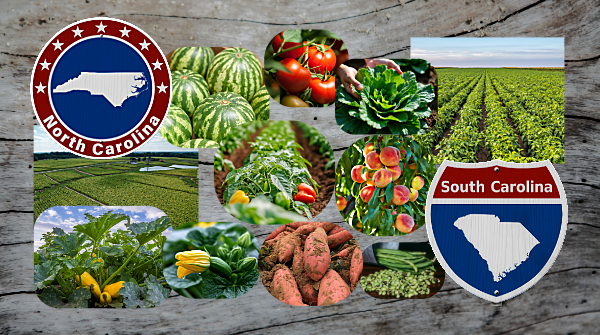
Karen Roach, David, physk, visoot, Ivan_s, ZaStock, zhang yongxin, Dionisvera, Italian Food Prod, Vadym, oticki, SBaty/Adobe Stock
In this article
Produce wholesalers and growers across North and South Carolina are reporting solid business, fueled by strong consumer demand for seasonal fruits and vegetables, despite drought conditions reported in both states.
Locally grown peaches, blueberries, watermelon, tomatoes, cantaloupe, and seasonal vegetables are performing well across the Carolinas. Higher costs, from inputs and freight to pricing for out-of-state crops, continue to present challenges.
For summertime snapshots from growers, repackers, and distributors located in both states, read on.
Sy Katz Produce, Inc.
For Boone, NC-based Sy Katz Produce, Inc. BB #:110216, drought has been an ongoing concern.
“Business has been challenging due to the drought,” confirms Ben Margolis, CEO and president of Sy Katz Produce. “It’s been a hot and dry summer. Our yields are down, but we’re starting to get some rain.”
Even though Sy Katz Produce uses drip irrigation for crops, Margolis says, “It was hard on our pepper and cucumber crops—but everyone was in the same predicament with the drought.”
On the bright side, as of mid-July, the farm’s organic mini watermelons were sizing up nicely. The farm recently expanded into organics focusing on bell peppers, green and yellow squash, eggplant, mini watermelon, and cucumbers.
Sy Katz Produce has about 360 acres for conventional crops and about 75 for organics. Margolis says the segue into organics was because his wholesale and retail customers asked for them. So several fields were transitioned over the last three years and are now suitable for growing organics.
Margolis, who studied sustainable technology at Appalachian State University, has an eye on the future. Part of the planned growth for the third-generation farm is attaining PrimusGFS certification, and a new packing and cooling facility will help.
Looking ahead, Margolis says the family business was built on a strong foundation and he’s upbeat about the future. “We’re working on a lot of growth.”
“It was hard on our pepper and cucumber crops—but everyone was in the same predicament with the drought.”
Ford’s Produce Company, Inc.
For Raleigh, NC-based Ford’s Produce Company, Inc. BB #:108825, local produce and a growing regional economy are driving business.
“We’re in a fast-growing town,” says Vaughn Ford, vice president and buyer, noting a thriving job market and many well-paid people moving there. “We have a very good restaurant scene in our area, and we’re mostly foodservice.”
As North Carolina’s summer harvest reaches its peak, Ford says customers are gravitating toward these fresh seasonal offerings.
“Right now, we’re into summertime fruits, like peaches and blueberries,” he shares, also mentioning vegetables. “We’re featuring a lot of squash, peppers, cucumbers, and eggplant—all of which are being picked locally.”
Rather than specializing in a handful of products, Ford’s Produce supplies a broad assortment of fruits and vegetables, a strategy he says reflects customer expectations more than business preference.
“It’s a requirement really more than a strategy,” Ford explains. “Our customers want to call one person and get all their produce vs. going to one guy for tomatoes and another guy for squash.”
The company primarily serves foodservice operators, and Ford believes customers are more knowledgeable and discerning about product quality. “Consumers and foodservice buyers are more educated than they’ve ever been, and it’s up to us to be on our A-game to have the best product we can.”
“We have a very good restaurant scene in our area, and we’re mostly foodservice.”
Wright Brothers Tomato Company, LLC
Ray Wright, owner of Wright Brothers Tomato Company, LLC BB #:121997 in Lawndale, NC, is also upbeat about his tomato-focused business, which sells to large wholesalers.
“Business has been really good for tomatoes,” he says. “We also do a few peaches, Vidalia onions, and other stuff.”
Although business has been solid, it hasn’t been easy, especially when working through higher input costs. “It impacts us,” Wright says. “We have to add them and pass them on.”
A 25-pound box of tomatoes that sold for $19 a box last year is about $3 higher this year, he says. In addition to higher input costs, growers continue to cope with the drought conditions in the Carolinas.
With much of North Carolina still experiencing overly dry conditions and severe drought in some areas, the lack of rainfall remains troubling. The situation is worse in South Carolina, where all but 10 counties were in severe drought status according to state reports.
“We’re in a historic drought right now,” Wright confirms. “Our water levels are down, but it hasn’t affected the quality of the produce because they can irrigate.”
Ford says many growers view excessive rainfall as a greater threat than dry weather. “I’ve heard many farmers say they can always put water on a field, but they can’t take it out when they have too much rain.”
“I’ve heard many farmers say they can always put water on a field, but they can’t take it out when they have too much rain.”
Mike’s Produce
Despite the drought in South Carolina, Michael A. Baker, general manager of Mike’s Produce BB #:206047 in West Columbia, SC, reports an especially strong peach season.
“It’s a bumper crop in South Carolina this year,” enthuses Baker. Beyond peaches, Baker says most crops are progressing as expected. “Everything is kind of on pace for where it should be.”
Baker operates a small business and says labor shortages are not an issue because family members are the employees and handle the work. “We’re just a small family-run place,” he says.
Like Ford and Wright, Baker believes consumers value fresh, locally grown produce. To promote local producers, South Carolina’s state branding program offers special labels and signage for consumers to more easily identify these items.
While Baker calls it a positive initiative, he says the state needs to promote it more. “It’s on the website, but they don’t really advertise,” he says, believing there’s plenty of room for improvement to drive awareness and sales of local products.
“It’s a bumper crop in South Carolina this year.”
R&H Produce Company, Inc.
Mark Yokeley, vice president of R&H Produce Company, Inc. BB #:108374 in Raleigh, NC, says his wholesale business has experienced a typical summer season with healthy demand for local making up for weaker sales of some higher-priced produce shipped from California.
“Certain things have been a little draggy, but others haven’t,” he notes. “It’s just typical summertime.” The biggest challenge has been rising prices on California-grown leafy vegetables following weather-related production issues.
“California sales are down because the price with all the weather issues out there is so high,” he says.
A receiver at the State Farmers Market, R&H Produce serves a diversified customer base including schools, restaurants, fruit stands, and wholesalers, which Yokeley says helps smooth out seasonal fluctuations.
This diversity is especially important during the summer months. “The school systems are out of school now, so that’s down,” he explains. “Then you’ve got your fruit stands and your local stuff—that picks it back up.”
North Carolina’s seasonal output is definitely a bright spot. “My watermelon, cantaloupe, and all that—are doing good,” Yokeley says. “No complaints.”
Overall sales, he adds, have remained consistent with previous years. “From year to year, it’s basically pretty close to the same thing sales-wise.”
“From year to year, it’s basically pretty close to the same thing sales-wise.”
Concluding Thoughts
While drought remains an ongoing concern in both North Carolina and South Carolina, irrigation has largely protected crop quality and kept the perishables supply chain moving.
This has been good news for growers and distributors in both states as their customers’ and consumers’ love of fresh, seasonal fruits and vegetables continues to bolster demand and spur the industry forward.



News you need.
Join Blue Book today!
Get access to all the news and analysis you need to make the right decision --- delivered to your inbox.






Subscribe to our newsletter
© 2026 Blue Book Services. All Rights Reserved

