
















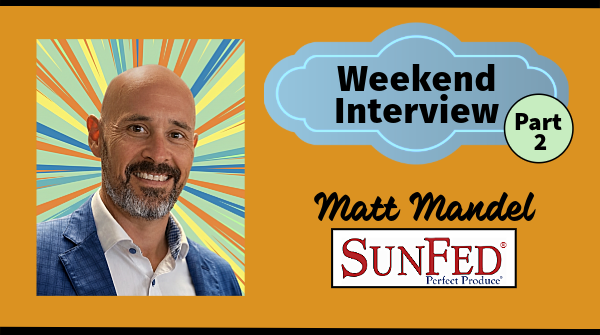
Matt Mandel, SunFed, Part 2
Welcome back! Here's Part 2 of anything and everything you always wanted to know about Matt Mandel and SunFed.
freeject.net/Adobe Photo
In this article
Based in Rio Rico, AZ with a branch in Pharr, TX, SunFed BB #:150037 is an importer and shipper of conventional and organic fruits and vegetables and part of GrubMarket, Inc. BB #:301166. Here’s the second half of our special interview with CEO Matt Mandel. If you missed the first part, find it here.
Q: As an early proponent of sustainability, tell us about SunFed’s efforts and what’s next.
It should surprise no one that I was a Boy Scout. Growing up I spent a lot of time in nature, backpacking, camping, and developed a love for this world we live in. It’s not just lip service that I feel we need to take care of the land that takes care of us.
I introduced SunFed’s Perfect Organics line of products as one of my first real projects in the company, when I naively thought organic and sustainability were one and the same. While organics and sustainability can overlap, they’re not synonymous.
For sustainability to last, it must also make financial sense. When we installed our solar array, it was the largest private installation in southern Arizona. Our solar panels offset up to 85 percent of our electricity needs.
We partnered with StePac in 2000 to leverage modified atmosphere and modified humidity packaging which both preserves commercial shelf life and also ensures more of what we produce ends up on a consumers plate.
We’re currently working with new biologics that will both restore soil health and increase productivity at the same time. Initial results indicate these products can also further reduce agrochemical use, making the whole process cleaner with the potential to lower input costs as we scale.
The three challenges I would prioritize are trade policy uncertainty, farm-level economics, and labor policies that increasingly make specialty crop production difficult to sustain.
Q: What do you consider the industry’s top three challenges going forward?
Trying to narrow it down to just three is difficult as there seems to be more turmoil now than ever.
The three challenges I would prioritize are trade policy uncertainty, farm-level economics, and labor policies that increasingly make specialty crop production difficult to sustain.
The top issue now is the morass surrounding USMCA and growing uncertainty over the U.S.’s long-term commitment to the agreement and proposals that could weaken integrated North American produce supply chains.
Dating back to its NAFTA predecessor, the fruit and vegetable trade, particularly with Mexico, has seen a dramatic increase in both imports and exports. Trilateral supply chains have been built up to service the industry, and it has been a huge benefit to U.S. consumers.
That said, I am cognizant there are sectors within U.S. production that feel they have been left behind by the agreement or put at a disadvantage, though it’s often posited as “unfair trade practices,” a sentiment I don’t agree with.
What I do agree with as a second challenge is producers in all three countries are being squeezed with real farm returns.
The economics of growing are under constant pressure from inflationary forces: seed costs, labor costs, input costs, diesel prices (which have risen dramatically of late due to the aforementioned geopolitical factor), etc.
…Everyone is willing to admit the system is broken, yet few policymakers have been willing to accept the political risk required to enact meaningful reform.
Farm input costs have risen much faster than the headline CPI inflation figures suggest. I truly do worry for the future of farming should this trend continue.
Lastly, the age-old refrain: labor availability and affordability.
Throughout many years of advocating for our industry in Washington, everyone is willing to admit the system is broken, yet few policymakers have been willing to accept the political risk required to enact meaningful reform.
The current administration has been receptive to and proactive on changes in farm labor policy; a welcome change. Unfortunately, it has fallen well short of what is needed to keep specialty crop farming viable.
Q: Is SunFed somewhat insulated as part of GrubMarket?
GrubMarket does not eliminate the fundamental risks of fresh produce, but it does give us access to technology and broader institutional resources.
These advantages can help us respond more quickly and operate more intelligently, even though the underlying market risks remain ours to manage.
On a day-to-day basis, SunFed continues to operate as an independent entity, with all the challenges, headaches, wins, and losses of anyone else in the fresh space.
Q: What do you enjoy most about your job? What’s most difficult?
Had someone told me years ago that this business was full of some of the best people on earth, I would have had to take the comment with a grain of salt.
What could possibly make this industry better than any other? This industry truly is filled with so many honest and hardworking people with vibrant personalities.
It really is one of my favorite things about my job. The most difficult part is our decisions have immediate impact on those same people.
So many factors can change quickly, and we often have to make consequential decisions with imperfect information.
I carry a very deep sense of responsibility, whether they’re my growers, their employees, and families, SunFed’s own family of amazing people, or the customers we strive to wow with Perfect Produce 24/7/365.
So many factors can change quickly, and we often have to make consequential decisions with imperfect information. This is so much more than a job to me—and I don’t take the responsibility lightly.
Q: Where do you see yourself by the end of the decade? Are there personal and professional goals you’d still like to achieve?
By the end of the decade, I intend to still be leading SunFed and building the next stage of its growth.
Professionally, my goal is to expand our grower network in both breadth and scope, deepen our relationships with the best customers in North America, and leverage technology to make SunFed more predictive, efficient, and valuable to customers and growers alike.
Personally, I want to remain present for my two awesome boys and foster their growth as well-rounded human beings. I hope to cultivate in them my love for the outdoors and nurture their sense of wonder about the world.
I would be remiss if I didn’t include my amazing wife who has steadfastly weathered the intrinsic ups and downs alongside me.
I’ve always had a dream to thru-hike the entirety of the Pacific Crest Trail, Continental Divide Trail, and Appalachian Trail, and maybe one day my boys will join me on that quest.
I am an extroverted introvert in an industry dominated by extroverted extroverts.
Q: Tell us something about yourself most people don’t know.
I am an extroverted introvert in an industry dominated by extroverted extroverts. It’s taken me a long time to get comfortable with that fact and find ways to survive and thrive while staying true to myself in that respect.
I’ve learned to embrace the act of deliberate listening, rather than waiting for a chance to speak.
It has taught me to be more intentional in how I build and maintain relationships. I still enjoy trade shows, grower visits, and customer meetings, but I am at my best when I approach them from a standpoint of how I can add substance and purpose.
Q: If you were writing a memoir, what would the title be and why?
I’ve known the title for years: The Plants Don’t Know It’s Christmas. Produce operates on the whims of markets and Mother Nature, not weekends and holidays.
The needs of this business truly do not leave a lot of wiggle room for true downtime; it requires a certain personality type to adapt to the natural rhythm.
There’s a common refrain in our business for folks coming into our industry, that you’ll know within a year whether you’re cut out for it or not.
Q: Anything else you’d like to share with our readers?
I am grateful for the people and lessons this industry has given me. Fresh produce is demanding, but it is also essential, innovative, and filled with opportunity.
SunFed will keep investing in the growers, people, and technology required to serve the next generation of customers and consumers.
News you need.
Join Blue Book today!
Get access to all the news and analysis you need to make the right decision --- delivered to your inbox.



Subscribe to our newsletter
© 2026 Blue Book Services. All Rights Reserved

