
















Industry Insights: From surplus to sustainability
Redirecting excess produce to those in need sounds simple enough but it's not. Read about Food Forward's three eras of food recovery.
eliyashevskiy/Adobe Stock
In this article
On November 12, 2025, on a crisp autumn Los Angeles morning, community members from Monrovia lined up outside the Santa Anita Family YMCA.
A line of vehicles stretched along the block where this textbook Southern California community center is situated, with families, older adults, and students all waiting to pick up bags packed to the brim with nutritious produce—something exceedingly scarce at most other community outreach events. But this was not a normal event or a normal time.
On November 1, the federal government had temporarily stopped funding SNAP, one of the country’s longest-standing and most successful food assistance programs, abruptly pausing benefits for nearly 42 million people nationwide.
During crises like these, Food Forward’s work becomes more vital than ever, as the produce we redirect may be the only healthy food community members can secure for weeks on end.
Our organization’s place in the “foodscape” is unique. We act as a high-volume bridge between the produce industry and community-based nonprofit organizations of all stripes. We’ve operated with over 500 produce donor sources this year alone, and many of these relationships reach well beyond a decade.
Performed at the lowest of costs, we handle the consistent recovery of abundance and take it to our distribution partners anchored in our region’s areas of greatest need. Be it urban, suburban, or rural, with state-of-the-industry logistics capacity, we respond quickly and with precision to hunger crises.
We’ve been laying the groundwork for this resilient food recovery system for nearly 18 years.
We’ve been laying the groundwork for this resilient food recovery system for nearly 18 years. Today, Food Forward responds to donors from across the region in minutes and redistributes volumes far beyond what was possible from even our largest regional food bank.
Because this logistics network is working so effectively, companies can partner with Food Forward to reduce otherwise wasted inventory, prevent greenhouse gas emissions, and contribute to social good.
Partners can also take heart that 98-plus percent of what might not be fit for human consumption (including packaging) is responsibly composted with our downstream sustainability partners.
Humble Roots
Our work started small—actually, with the harvesting of a single San Fernando Valley tangerine tree, producing 85 pounds of the freshest citrus available.
We have now scaled to an operation which helps 16 California counties every month, redistributing enough fresh produce to feed over 300,000 people every single day.
Responding to community needs during a crisis is in our organization’s DNA. During the Great Recession, I was in my Valley Glen neighborhood, walking my dog on our usual loop, when I began to notice abundant citrus scattered across the ground beneath my feet.
With widespread job losses, shrinking household budgets, and growing economic uncertainty, I was worried about the many Angelenos facing food insecurity and saw a solution literally and figuratively within reach.
It felt obvious to organize a volunteer food recovery harvest to capture what was going to waste and make sure it ended up on the plate of someone in need.
It felt obvious to organize a volunteer food recovery harvest to capture what was going to waste and make sure it ended up on the plate of someone in need.
This grassroots harvest supplying tangerines to a local food pantry was the beginning of Food Forward. With a swell of enthusiastic volunteers and homeowners, the idea took off and we ended our first year with over 100,000 pounds of free produce channeled to hunger pantries.
After creating this first program, aptly named Backyard Harvest, we brought organized gleaning to farmers markets. We work with hundreds of volunteers annually alongside farmers to help them stay sustainable and reduce waste. We now glean at nearly 20 markets across two SoCal counties.
Going to Scale
In 2014, we hit paydirt with our Wholesale Recovery Program, bringing our recovery efforts to an entirely new level of impact and efficiency. To build the program, we forged long-term, win-win-win food recovery and sustainability relationships with the grower-packer-shipper community that feeds our country.
We’re one of the sole entities able to help recover truckloads of produce that would overwhelm smaller recovery efforts. Even multiple loads of a single crop don’t deter us.
Barely five years after the start of our Wholesale Recovery Program, the world as we knew it was rocked again, by the Covid pandemic. By this point, Food Forward was an established organization.
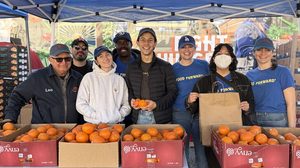
Eight months earlier, we had opened the Produce Pit Shop in Bell, CA. This refrigerated access point turned out to be crucial to produce redistribution for the length of the pandemic, keeping fresh fruits and vegetables moving into communities when many of the food channels people had relied on ground to a halt.
From Crisis to Crisis
From 2020 to 2025, Food Forward grew 300 percent.Just six days into the new year, we answered the sudden call to support those affected by the Los Angeles wildfires and put our expanded operational capacity to use. Our longstanding relationships with growers, packers, and shippers proved indispensable.
Not six months later, Los Angeles was again shaken, this time by immigration raids that kept many workers away from their employment, expanding the need for fresh food. We responded by working with our trusted distribution partners to change access points to ensure the continued availability of food.
Then, in November, the long federal government shutdown caused a SNAP funding disruption. With support from multiple partners we were able to meet this need as well.
Prior to these unprecedented moments of destabilization, our nearly 18 years of experience had created the bedrock upon which we could provide people with one piece of certainty during frightening times: healthy produce on the table.
For the one in four people facing hunger in Los Angeles, and one in five nationwide, that certainty is health. It’s dignity and empathy, plain and simple. Healthy food access reduces the risk of multiple chronic diseases.
We know it’s more effective and efficient to invest in prevention than a cure.
The impact our continuous growth has allowed is stunning: during the entirety of 2025, we moved over 100 million pounds of produce into communities in need.
The produce industry has long given fruits and vegetables that can’t be sold to food insecure community members. Food Forward provides coordination, cold storage, end-to-end transportation, and the ability to take much more of what is offered. All of this happens via a model that ensures produce consistently goes where it is most needed.
We welcome new partnerships with organizations in the produce industry—large and small—who share our vision of reducing waste and supporting those in need. To partner with Food Forward, learn more at foodforward.org/wholesale.
News you need.
Join Blue Book today!
Get access to all the news and analysis you need to make the right decision --- delivered to your inbox.





Subscribe to our newsletter
© 2026 Blue Book Services. All Rights Reserved

