


















Canada, Part 1: Market growth with tempered expectations
For the first portion of our True North coverage, Ron Lemaire and suppliers discuss market disruptions, surging prices, and what's ahead.

djvstock/Adobe Stock
In this article

As an economic engine, the Canadian produce industry remains on solid ground. According to Statistics Canada, farm-gate value for both fruits and vegetables climbed in 2025.
Fruit led the way in terms of growth, with sales rising 16.8 percent to $1.6 billion, while vegetables had higher sales, at $1.8 billion, but a lower growth rate at 7.1 percent. As always, weather played a role affecting some crops across the country, but higher pricing helped with gains.
Part of what drives demand is the True North’s diverse population. The usual stalwarts like apples, berries, cherries, potatoes, onions, and carrots always sell, and lettuce and leafy greens from controlled environments do too, especially when traditional field growers are out of play.
But the popularity of specialty items continues to surge with tropical fruits, specialty citrus, and ethnic vegetables leading the way.
Overall, Ron Lemaire, president of the Ottawa, ON-based Canadian Produce Marketing Association BB #:153602 (CPMA), says ethnic fruit sales rose 13 percent from the first quarter of 2025 to the first quarter of this year.
As this year’s season gets underway, with geopolitical and weather uncertainties looming large, Lemaire remains cautiously optimistic, characterizing the current outlook as “modest growth in very turbulent times.”
“Our world of fruits and vegetables relies on predictability, rule of law, and regulations that are science- and fact-based and trade enabled.”
Trade Tidings
Market volatility is nothing new to the perishables landscape, but our sources confirm politics are having more of an impact than in the past.
Given the United States has long been Canada’s chief trading partner, recent trade and economic policies have added layers of frustration and roadblocks both real and metaphorical.
Lemaire says CPMA has been tracking local sentiment on American produce since last March and the issue has polarized many Canadian consumers.
According to CPMA research from March of last year, 59 percent of polled Canadians said they would not buy American produce and 16 percent said they were trying to avoid it.
By March of this year, the number of hardliners not buying U.S.-grown produce had decreased to 41 percent but those trying to avoid it had risen to 23 percent. Rising prices, however, will also continue to influence these buying decisions.
For those who earn their living from buying and selling fresh produce, negotiations over the U.S.-Mexico-Canada (USMCA) trade agreement are top of mind, with everyone hopeful details will be ironed out in a fair and equitable way.
“Our world of fruits and vegetables relies on predictability, rule of law, and regulations that are science- and fact-based and trade enabled,” states Lemaire, stressing USMCA negotiations must ensure certain mechanisms are in place for trade functions.
Hutch Morton, senior vice president at J.E. Russell Produce Limited BB #:115731, a Toronto distributor based at the Ontario Food Terminal, puts it this way: “This year’s review of USMCA is the most significant risk to the fresh produce industry in Canada.
“If it’s renewed for an additional 16 years through 2042, the industry will have the free and fair trade certainty it needs to thrive. If it doesn’t move forward, that will have major consequences for consumers and growers across North America.”

Supply Fluctuations
Trade negotiations aside, it’s business as usual, or as close to it as possible.
At Courchesne Larose Ltée. BB #:115999, a Montréal, QC wholesaler and importer/exporter, Guy Milette, executive vice president, admits the past year has been a difficult one.
Among his chief complaints are two familiar yet not easily controlled variables: economic factors and the weather. He says Mother Nature wasn’t a particularly good partner at times last year, referring to disruptions in planting and harvesting, which drove up prices.
In the past couple of months, a case of celery has doubled from last year, he mentions, and pricing on lettuce, broccoli, and cauliflower have all risen too.
Mike Soufan, owner and CEO of distributor and retailer Freestone Produce Inc. BB #:299600 in Calgary, AB, has his own examples of wild price shifts: in early March, he paid $15 for a 25-pound case of Roma tomatoes one week and $50 another. Broccoli was $10 per case one week and then $40 the next.
“I’ve never seen it like this,” he says. Much of his sales volume is from the area’s immigrant community and Soufan has adjusted his offerings for his clientele, adding okra, mangos, grapes, bananas, papaya, various unique melons, and persimmons to the mix.
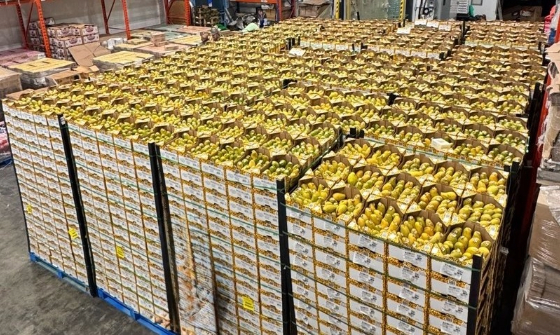
These items come mostly from California and Mexico, with up to 80 percent of Freestone’s produce coming from Mexico during the winter months.
But this year, he notes, supply has been especially inconsistent, which he attributes to pricing, weather, and availability.
For Nash Dattani, president of Dattani Wholesalers BB #:128244 in Calgary, AB, an importer and distributor of specialty foods, fuel costs are a significant thorn.
“Right now, we’re just trying to stay status quo—it’s so expensive to import,” Dattani says. In mid-March, he paid an extra $2,000 for a load from California due to higher fuel costs.
The costs will ease once Canadian-grown products come to market, when Dattani can switch to local vegetables like iceberg lettuce. He’s also exploring other import options, including Africa.
Preparing for What’s Ahead
“The economic pressure is tough,” says Milette. “Tariffs have brought a lack of balance, but we continue with business as it is and bring in options.”
Courchesne Larose Ltée. relies heavily on U.S. suppliers. “We need everything every day, all of the time,” emphasizes Milette, with the company bringing in 500 loads a week of fruits and vegetables. Fruit represents 60 percent of volume, and the company is one of the largest banana ripeners in the country.
Adjustments are made continually, he says, based on local product and various conditions with trading partners. But, he points out, “Sometimes it’s out of our control.”
“No amount of sourcing diversification can soften the blow of a tough growing season or untimely weather disruptions in a key category.”
Morton concurs. “No amount of sourcing diversification can soften the blow of a tough growing season or untimely weather disruptions in a key category.”
Although J.E. Russell is well known for berries, Morton says the company has strong relationships with grower-shippers handling salad mixes, organic vegetables, grapes, pineapples, mushrooms, and other categories.
“Deepening and strengthening these partnerships is what makes us successful,” Morton adds.
At Freestone Produce, Soufan is looking forward to a new facility: converting a former Toys “R” Us location, with 400 parking spots, into a 60,000-square-foot warehouse and market for cash-and-carry business. It opens in July.
His existing warehouse, which is attached to a retail store, will also be expanded to 60,000 square feet.
Despite the mayhem this year so far, Morton is still a superfan of the industry.
“The produce industry is one that will always keep you on your toes, but it’s what makes it fun to come to work every day with a simple goal of delivering the highest-quality produce to our customers at the right price, every time.”




News you need.
Join Blue Book today!
Get access to all the news and analysis you need to make the right decision --- delivered to your inbox.






Subscribe to our newsletter
© 2026 Blue Book Services. All Rights Reserved

