

















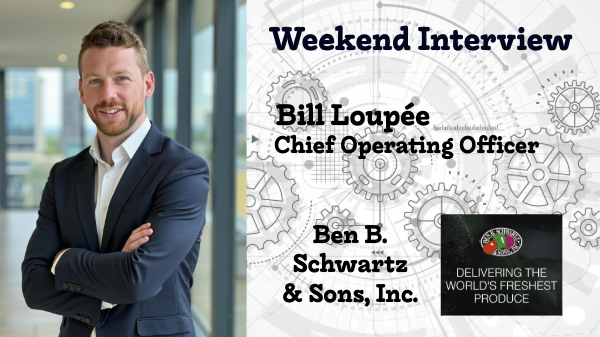
Bill Loupeé, Ben B. Schwartz & Sons, Inc.
If you're not familiar with Bill L. and Ben B., you're missing out. Let us fill in the blanks with our latest Weekend Interview.
royyimzy/Adobe Stock
In this article
Founded in 1906, Ben B. Schwartz & Sons, Inc. (Ben B.) BB #:104793 is a fixture in Detroit’s fresh produce industry. Originally a small retailer, the now fourth-generation company is a wholesale distributor operating out of the Detroit Produce Terminal, selling to retailers and foodservice customers across the Midwest and beyond.
Bill Loupeé, who is chief operating officer, joined the company in 2020. We asked him to weigh in on today’s unpredictable business environment, how the company is navigating the industry’s ups and downs, and what lies ahead for this venerable supplier.
Q: Tell us about your education and original career ambitions.
I have an undergraduate degree from Miami University in Ohio and a master’s degree in supply chain management from Michigan State. I am also a licensed custom broker.
I’ve always been drawn to the logistics space. Between freight brokerage, transportation, warehousing, and ecommerce fulfillment, it’s the biggest industry that sits in the background of our everyday lives.
It’s also constantly evolving with exciting technological developments, making it a great industry to grow with. And with innovation comes opportunity—that’s what anchors my favorite part of this business, finding new ways to elevate the customer experience.
I’ve always been drawn to the logistics space. Between freight brokerage, transportation, warehousing, and ecommerce fulfillment, it’s the biggest industry that sits in the background of our everyday lives.
Q: You were in logistics before landing at Ben B. Schwartz, did you handle perishables or refrigerated freight? How did you segue into the produce industry?
I have a very diverse background in logistics, building my career over a decade in everything from dry freight to perishables, and even FEMA (Federal Emergency Management Agency) disaster relief loads. The produce industry is a vital one, and I was able to leverage these past experiences into my current role as chief operating officer.
The Billmeyer family approached me with the opportunity to join Ben B. at a time when sales were skyrocketing but the old company infrastructure was struggling under the weight of this growth. I knew I could make an impact while having a chance to pivot, learn, and grow in my own career.
Q: What do you enjoy most? What’s most difficult?
Technology will always be critical for any business—helping it run better and faster—but I know that a company’s people are what truly make it a success. We have an incredibly passionate and dedicated team here at Ben B. and I love when we can bring employees together with technology to solve problems.
When I worked directly in supply chain management, we were always trying to double throughput while keeping headcount. This meant applying new tech where possible but using those tools to complement the hard work of our team instead of replacing it—and that’s what I try to do at Ben B. whenever possible.
The challenge we face in the produce industry is its perishable nature. When you’re dealing with a commodity that begins dying as soon as it’s picked in a field, you’re in a race against time. That’s why speed and accuracy are key, and we work around-the-clock to deliver the freshest produce and best experience possible to our customers.
At its core, I know this business thrives because of the people behind it. It’s what informed my logistics career and guides me today.
Q: How much does your logistics background influence daily decisions or how you view and address business dilemmas?
At its core, I know this business thrives because of the people behind it. It’s what informed my logistics career and guides me today.
I focus on being a good leader first and foremost—treating everyone with respect as a person before an employee, earning their trust, and bringing stakeholders together on projects so they’re invested in the outcome—all while creating a culture where we embrace change as a team and get better together.
Q: You’re a licensed customs broker, what type of training did this entail?
I began researching the application process for the Harmonized Tariff Schedule (part of the U.S. International Trade Commission), then passed the customs broker license exam. I started this process at a previous employer to make it part of its suite of 3PL services, but it has served me well in my current role to manage imports from several countries or exporting to Canada.
Q: In thinking about terminal markets across the country, how does Detroit compare in terms of recent or ongoing upgrades, supply availability, and traffic flow?
What makes Detroit unique is its strong network of independent retailers, and they have high expectations for the quality and types of product coming out of the city.
It means we have to carry the best, freshest produce possible while also offering a broad range of commodities. It’s also helped us expand beyond the city to other Midwest and Southern markets that previously didn’t have access to this level of quality or offerings.
Q: With retailers and restaurants forging direct partnerships with growers, what can wholesalers do to make themselves indispensable?
We help retailers and restaurants focus on what they do best—selling food to consumers—and give them the agility they need to keep their businesses humming, such as: 1) providing value-added services they’d normally have to outsource or absorb themselves, such as repacking, bagging, precutting, and more; 2) having a grower network to easily acquire product if their go-to grower experiences crop failure, weather issues, or other challenges; 3) offering storage and acting as a consolidating point or distribution center if they don’t have or can’t afford their own; 4) reducing transportation costs by combining deliveries to reduce freight expenses by cost per case; and 5) providing better overall market insights on demand and conditions so they can order smarter.
Sustainability is a big focus area for us, as is community, and we recently partnered with Sharing Excess to reduce food waste.
Q: How much emphasis is the company placing on sustainability to ensure future success?
Sustainability is a big focus area for us, as is community, and we recently partnered with Sharing Excess to reduce food waste. We donate any produce unfit for sale to the organization to distribute to local programs throughout Detroit for meals, composting, or for animal feed.
Since we began in April, we’ve donated nearly 1 million pounds of produce and are proud to support the people and organizations in our backyard.
It’s also important to offer sustainable options to our customers when it comes to bagging and packaging instead of plastics. And we also like to practice what we preach—for example, we use an EV yard switcher to move equipment, and we’re always looking for ways to be more eco-friendly now and in the future.
Q: What technology tools have become essential to doing your job? Or for the company as a whole?
We value tools to make us work better so much we built our own—called Ben B. Access. It’s a proprietary platform that includes TMS, order entry tools, data analytics for buyers and sellers, a form of EDI for customers who don’t operate on an ERP platform, a driver app, and more.
When we looked at the off-the-shelf options, we didn’t see a comprehensive solution we could grow with, and that’s what Ben B. Access lets us do. We’ll continue to add features and make it better over time, improving both our operations and the customer experience.
Q: Do you see expansion in the company’s future? If so, in what ways?
We’re always focused on growth and propelling the Ben B. brand to new heights. We do this in two ways: first, we’re expanding our distribution, targeting opportunities in North Carolina, Georgia, Tennessee, Arkansas, and Missouri.
Second, we’re also always looking to expand our suite of services, from bagging to cutting. This is where our company provides its greatest value-add, rolling in this layer of work as part of every order so when it arrives, it arrives ready for however our customers need it.
Going forward, we’re planning to expand our facilities and invest in even more technology tools to support our growth.
Q: Where do you see yourself by the end of the decade? What personal and professional goals would you like to achieve?
I was fortunate to participate in Class 27 of the IFPA’s Leadership Program. During my time, one of our mentors, Julie Krivanek from Krivanek Consulting, challenged me to make the Detroit Terminal Market better than any other in the United States—that’s what I’ve been focused on doing and will continue to do.
News you need.
Join Blue Book today!
Get access to all the news and analysis you need to make the right decision --- delivered to your inbox.





Subscribe to our newsletter
© 2026 Blue Book Services. All Rights Reserved

