


















Exclusive! Know Your Commodity: Eggplant
This Know Your Commodity excerpt is sponsored by Yates Produce, LLC.
nuttakit/Adobe Stock
In this article
Want to know more about eggplant? Our Know Your Commodity profiles provide in-depth information on dozens of fruits, vegetables, herbs, and nuts. We’re highlighting a few sections of our Eggplant coverage below, sponsored by Yates Produce, LLC BB #:397790; the full profile can be found here.
Types & Varieties
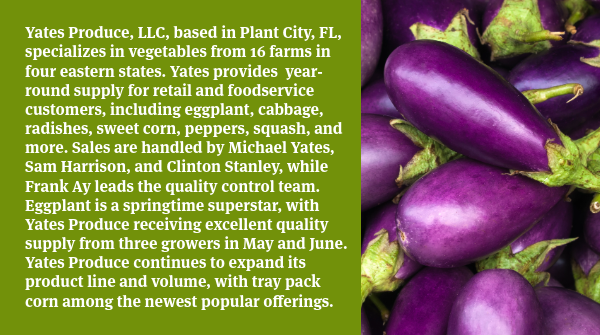
Part of the nightshade (Solanaceae) family, eggplant was once thought to be poisonous. When eggplant arrived in Italy, it was called the “mad apple” and reputed to make people who ate it go crazy. The leaves and flowers, when consumed in large quantities, can be poisonous, but not the fruit.
Eggplant is related to tomatoes, potatoes, and peppers, and goes by many names including eggfruit, aubergine, brinjal, and nasubi.
Eggplant comes in two basic families: Solanum melongena, the traditional eggplant with a solid, fleshy inside, and Solanum integrifolium and Solanum gilo which are more like tomatoes with a soft inside and hence called “tomato-fruit eggplant.”
Common eggplant is dark purple or black, 6 to 9 inches long, bulb-shaped, and 3 to 4 inches wide at the base. Varieties include Black Bell, Black Beauty, and Black Magic. Other large-fruit varieties include Dusky, Epic, Classic, Burpee Hybrid, and Ghostbuster.
Eggplant also comes in elongated varieties such as the Ichiban, Slim Jim, and Little Fingers. There are several popular Asian cultivars including Orient Express, Orient Charm, Calliope, and Machiaw, as well as ornamental varieties including the Easter Egg.
Asian varieties have softer skin and ornamental varieties are small, oval-shaped, and often whitish in color. Tomato-fruit eggplant can range in color from green to red to orange, and even be striped or bicolored.
Cultivation
As a crop, eggplant loves heat and full sunlight but does not like frost. It grows best in rich sandy or loamy well-drained soils with a pH between 5.5 and 7. Plants require several months of sun to bear fruit, so seedlings should be planted well before the last frost is expected.
Plants prefer temperatures between 70 and 85°F. Flowering and fruiting can slow or stop at temperatures below 60°F and above 95°F.
Star-shaped ?owers will grow on thick stems and self-pollinate, producing various sizes of purple, black, and sometimes white or striped fruit, depending on the variety.
Mature plants can reach 8 feet in height. Fruit can be harvested when skin is firm and shiny, and is edible from about one-third of full size through maturity. Too-mature fruit can become hard and bitter.
To produce larger eggplant, remove other fruit to allow the plant to send nutrients to just one or two. Harvesting by hand with clippers is best; typically the cap and a short piece of stem are left on.
Inspector’s Insights
- There is no requirement for the color of the calyx; a calyx turning brown and dry is not a defect
- For U.S. No. 1, eggplant must be reasonably uniform in size: the weight of the smallest fruit is not less than half the weight of the largest
- Brown discoloration is scored as a defect when affecting more than 10% of the surface
- Shriveling is scored as a defect and serious damage when affecting more than 5% of the surface.
Source: Tom Yawman, International Produce Training, www.ipt.us.com.
News you need.
Join Blue Book today!
Get access to all the news and analysis you need to make the right decision --- delivered to your inbox.





Subscribe to our newsletter
© 2026 Blue Book Services. All Rights Reserved

