
















Alexandra DeSorbo-Quinn & Pilot Light
By bringing fresh produce into classrooms, Alexandra DeSorbo-Quinn and Pilot Light are turning kids into devoted consumers.
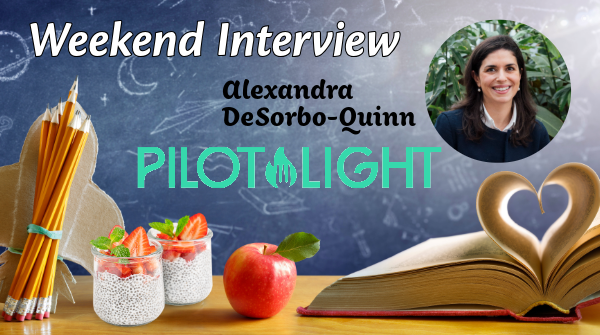
Romolo Tavani, Elena/Adobe Stock
In this article
Alexandra DeSorbo-Quinn is the executive director of Pilot Light, a Chicago, IL-based nonprofit founded by four chefs to provide teacher-based, focused food education in school classrooms. When kids are curious and excited about food—especially fruits and vegetables—they’re more likely to become lifelong consumers and proponents of healthy eating.
Operating through seven specific food-themed standards, Pilot Light programs have reached over 500 classrooms in 26 states nationwide. As its website proclaims, “Food is personal, cultural, political, and nutritional to both the mind and the body.”
Q: Tell us about your education, background, and early career ambitions.
I grew up in upstate New York and went to Bryn Mawr College in Philadelphia, where I was first introduced to the field of public health. I was fascinated by the idea of working at the population level—shaping conditions to help people live healthier lives—and that curiosity led me to pursue graduate studies in public health at Columbia University, where I specialized in epidemiology and health promotion.
From the very beginning, I wanted to understand how we could create environments to support children and families before health problems arise. Early in my career, I worked with teams at Harlem Hospital and Columbia University to develop school-based health education programs using hip hop music as a teaching tool. The impacts were amazing: students were engaged, taking what they learned home to their families. I saw firsthand how powerfully young people responded when learning through the arts.
That foundation shaped the path I’ve followed ever since. I became focused on building sustainable community partnerships to help leverage schools as a vehicle for lifesaving information that can impact us all. Over time, my work expanded into nonprofit leadership, but the throughline has always been the same: ensuring all children have access to meaningful, engaging education that supports their overall wellbeing.
It’s one thing to read and understand a nutrition facts label; it’s another to grasp how food shapes your life, your relationships, and the broader world around you.
Q: How did you land at Pilot Light in 2014?
By 2014, I had spent nearly a decade working in public health. I loved the work and the impact of school-based health education programs. But I also felt a pull toward something to connect the dots between health, education, and the everyday experiences of children and families.
It’s one thing to read and understand a nutrition facts label; it’s another to grasp how food shapes your life, your relationships, and the broader world around you. That’s where people begin to care.
When I learned about Pilot Light, it immediately resonated. Here was a small but visionary organization founded by an incredible group of chefs who believed food could be a powerful tool for education. What excited me most was their concept of partnering with teachers—trusted adults in students’ lives—to weave food education into everyday learning.
Pilot Light’s chefs had proven the concept in one Chicago school and needed help to build the infrastructure, programs, and partnerships to grow the work. I remain deeply grateful they trusted me to take on that challenge.
Q: What was the impetus behind its creation?
Pilot Light was born out of a very particular moment in time. In 2010, national attention was turning toward childhood health, largely because of the Let’s Move campaign led by First Lady Michelle Obama. She was shining a spotlight on the urgent need to address child nutrition, not just through policy, but also through education and community action.
In Chicago, a group of chefs who shared that passion—Paul Kahan, Matthias Merges, Justin Large, and Jason Hammel—began asking how they could be part of the solution. Their idea was simple but powerful: chefs working alongside teachers to integrate food into everyday lessons, not as an “extra” subject but as a lens for math, history, literacy, and science.
From there, it grew into the model we continue to build on today: food education woven into the fabric of learning, led by teachers, and grounded in the belief that food connects us all.
Q: As a nonprofit, how does the organization support itself? Do you receive federal and state grants?
Like many nonprofits, Pilot Light is sustained through a mix of philanthropic and public support. We rely on contributions from individuals, family foundations, and corporate partners who believe in the power of food education.
We also pursue federal and state grants. For example, we’ve partnered with state departments of education, received USDA Fresh Fruit and Vegetable Program support, and secured funding through a specialty crop block grant.
Ultimately, our model is intentionally diverse: philanthropy helps us stay nimble and community-centered, while public funding ensures our work can integrate with larger policy efforts.
Ultimately, our model is intentionally diverse: philanthropy helps us stay nimble and community-centered, while public funding ensures our work can integrate with larger policy efforts. This balance has been critical to sustaining our growth and making sure food education is a lasting part of how schools support children.
Q: Do you have special events and fundraisers?
Yes. We host special events and fundraisers each year to not only generate critical support but also celebrate the community around our mission.
Our signature event is the annual Feed Your Mind Gala, which brings together chefs, educators, donors, and partners for an evening that highlights the power of food education. In addition to the gala, we host smaller gatherings and community events throughout the year.
Q: The group recently updated its Seven Food Education Standards; how much did they change?
Great question. The core of the standards has stayed the same. They remain our roadmap for what every child should know and be able to do when it comes to food education. What changed in the 2025 update is really about refinement and depth.
Over the past seven years, hundreds of teachers have used the standards in classrooms across the country and we’ve learned from their feedback. The revisions reflect these classroom experiences: the language is clearer and the connections to academic subjects are stronger. Further, we expanded the Standards to include PreK, they were originally K-12.
For example, we strengthened the alignment between food education and core subjects like science and literacy—so a lesson about food systems can also reinforce concepts like ecosystems, or a discussion about recipes can support reading comprehension and writing skills.
Food is never just about what’s on the plate; it’s about relationships, culture, memory, and the ways we pass on values and traditions, whether in a family kitchen or in a classroom.
Q: Which ones resonate most with you and why?
The standard that resonates most deeply with me is Food Connects Us to Each Other. It captures the heart of why food education matters, not just as a way to teach nutrition or health, but as a way to build empathy, understanding, and community.
I see this come to life in my own home. One of my favorite things to make with my three kids is our family “sauce” recipe. It’s been passed down from my grandmother to my dad, then to me, and now to them. At each step, it’s evolved and changed a little, but it still carries the original spirit and history of our family. It conveys the idea that food tells a story bigger than any single meal.
Food is never just about what’s on the plate; it’s about relationships, culture, memory, and the ways we pass on values and traditions, whether in a family kitchen or in a classroom.
Q: Which standards are most difficult to convey and/or put into action?
The most challenging standards to put into practice are probably those asking students to think beyond their immediate experience, like “Food behaviors are influenced by internal and external factors,” or “We can make informed food choices.”
These ideas are incredibly powerful, but they can feel abstract, especially for younger students who don’t yet see how their individual choices are linked to larger systems like agriculture, climate, or the economy.
This is where teachers really make the difference. When educators ground these standards in hands-on, relatable activities. If we can help students understand the bigger picture—the impacts of their choices—we’re not just teaching them about food, we’re equipping them to be thoughtful citizens who can make informed decisions that impact their health, their communities, and the planet.
Q: Tell us about your responsibilities, do they change with the academic year?
Not really. The core of my role—leading our team, building partnerships, fundraising, and ensuring we’re delivering strong programs—remains steady throughout the year.
That said, the pace and focus can shift. For example, summer tends to be a time when we’re developing resources, training teachers, and planning ahead, while the school year is when we see the work come alive in classrooms. But overall, my responsibilities are consistent year-round since our mission requires both long-term strategy and day-to-day support for educators no matter where they are in their calendar.
By pairing the tasting experience with engaging activities, teachers can leverage a resource that’s already in their classrooms and turn it into a meaningful learning moment.
Q: What types of activities related to fruits and vegetables are most popular in classrooms?
Our SnackTime Explorers program has been especially popular because it helps teachers make the most of the USDA Fresh Fruit and Vegetable Program by bringing new produce into classrooms and providing ready-to-use lessons connecting directly to these fruits and vegetables.
By pairing the tasting experience with engaging activities, teachers can leverage a resource that’s already in their classrooms and turn it into a meaningful learning moment.
Q: Tell us about the Food Education Fellowship and how fellows are selected.
The Food Education Fellowship is one of Pilot Light’s signature programs. It’s a year-long, professional learning community for classroom teachers passionate about bringing food education to life with their students. Fellows receive training, coaching, and a stipend to design and implement food-based lessons, and they also help us refine resources and share best practices nationally.
The selection process is competitive because we want to bring together a diverse group of educators who represent different grade levels, subject areas, and communities. We look for teachers who are creative, committed, and excited to use food as a lens for learning.
By the end of the year, fellows have not only impacted their own students, but they serve as ambassadors of our mission. They become part of a growing network of teacher-leaders driving this work forward across the country.
Q: How many fellows do you have each academic year?
Now, typically about 25, spanning grade levels, content areas, and communities nationwide. We’re in our 7th year and have supported over 150 teachers nationwide in this work.
Right now, the Center houses more than 135 lessons aligned to our Food Education Standards, with activities spanning subjects like science, literacy, math, and social studies.
Q: Tell us about the Food Education Center.
The Food Education Center is Pilot Light’s digital hub for teachers. It’s where all of our lessons, resources, and professional learning opportunities live. We built it to make food education accessible and practical for educators everywhere, whether they’re in a large urban district or a small rural community.
Right now, the Center houses more than 135 lessons aligned to our Food Education Standards, with activities spanning subjects like science, literacy, math, and social studies. Many are bilingual and designed to be flexible, so teachers can adapt them to their classrooms.
Q: What else would you like to share with our readers?
Right now, Pilot Light is at an exciting and important moment of growth. Our goal is to expand our reach thirtyfold over the next several years, growing to reach 10,000 teachers and 300,000 students nationwide. We know that food education has the power to improve health, academic outcomes, and community connections, and we want every child to have access to it.
This work is especially urgent because of the recent federal cuts to SNAP-Ed, which traditionally supported nutrition education for children. Schools and communities are feeling that gap, and Pilot Light is stepping in to help fill it.
By equipping teachers with resources, training, and support, we’re ensuring that students still get the chance to learn about food in ways that are meaningful, joyful, and connected to their everyday lives.
We believe food education should be a lasting part of every child’s school experience, and with the support of partners and communities, we’re on a path to make that vision a reality at scale.
News you need.
Join Blue Book today!
Get access to all the news and analysis you need to make the right decision --- delivered to your inbox.


Subscribe to our newsletter
© 2026 Blue Book Services. All Rights Reserved

