



















Retail produce sales remained soft in September
Department dollar sales came in at $7.2 billion, down 1.8% ($129 million) from a year ago, while units fell 3.2% and pounds slipped 0.5%.
Images courtesy IFPA
Fresh produce sales in retail continued to struggle in September, according to the latest International Fresh Produce Association BB #:378962 Retail Produce Performance report from 210 Analytics and Circana, covering the four weeks ending September 27, 2026.
Department dollar sales came in at $7.2 billion, down 1.8 percent ($129 million) from a year ago, while units fell 3.2 percent and pounds slipped 0.5 percent.
On a 52-week basis, though, produce is essentially flat in both dollars and volume.
The wider economy continues to be a problem. Gas prices climbed back to May’s peak, hitting $4.15 a gallon over Labor Day, according to AAA, and shoppers again had to split budgets between the pump and the grocery store.
Total food and beverage units were flat (down 0.1 percent), and report author Anne-Marie Roerink of 210 Analytics, says they would have been positive without produce’s ongoing recall-related losses.
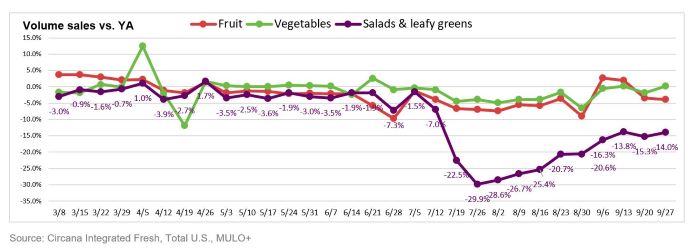
Most of those losses trace back to salads. Salad and leafy greens units fell 16.4 percent for the month, and salad kits dropped 28.3 percent in dollars, the steepest decline among top sellers. Volume was down 29.9 percent in the first full week after the July Cyclospora outbreak and had recovered to within 14 percent of last year’s level by the final week of September.
Low food inflation is generally good, but in this case, fresh produce pricing worked against dollar growth. Overall produce averaged $1.86 per pound, down 1.2 percent, with vegetables falling 1.7 percent to $1.97 and fruit off 0.8 percent at $1.75.
That ran counter to the rest of the store, where food and beverage prices rose 2.2 percent and center-store items 3.5 percent. Even during Labor Day week, when pound sales grew 1.3 percent, produce dollars stayed below year-ago levels.
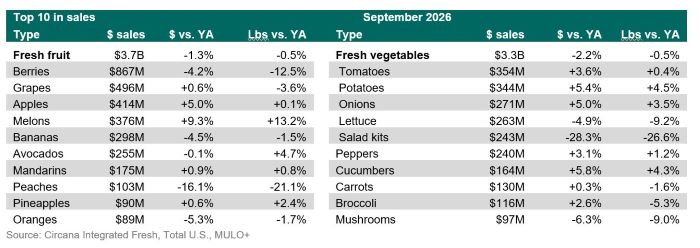
Plenty of categories grew in September. Melons led absolute dollar gains at $32 million, with 13.2 percent more pounds, followed by kiwis ($22.3 million) and sweet potatoes ($20.7 million), whose pound sales jumped 33.9 percent and 29.4 percent on social media buzz and demand for fiber-rich, nutrient-dense foods.
Vegetables took seven of the top 10 growth spots, a reversal from fruit’s dominance through 2025 and early 2026. Potatoes, onions, tomatoes, cucumbers, and peppers all grew in dollars and pounds. Berries, the largest fruit category, lost 4.2 percent in dollars and 12.5 percent in pounds, and peaches fell 16.1 percent.
Other forms of produce performed better in the month. Frozen fruits and vegetables dollar sales rose 6.4 percent to $827 million, and shelf-stable fruit and vegetables together topped $1 billion with mid-single-digit dollar gains.
Among perimeter departments, meat and seafood grew while produce, deli, and bakery lagged.
Looking ahead, the report points to slightly smaller spending this holiday season (National Retail Federation projects $890 per person, down 1.3 percent), continued gains for club stores and online grocery, AI emerging as its own shopping channel, and a consumer health focus that increasingly centers on protein, especially among GLP-1 users.
News you need.
Join Blue Book today!
Get access to all the news and analysis you need to make the right decision --- delivered to your inbox.






Subscribe to our newsletter
© 2026 Blue Book Services. All Rights Reserved

