

















ProduceIQ: No holiday for the heat
The fireworks may be over, but the weather isn't finished putting on a show, as the summer weather pattern flips westward this week.

Images courtesy ProduceIQ
The fireworks may be over, but the weather isn’t finished putting on a show.
The summer weather pattern flips this week as the nation’s heat dome shifts westward. NOAA’s Climate Prediction Center is forecasting an elevated risk of extreme heat across much of the Western and Central U.S. into mid- and late July, while regional meteorologists say interior California could experience some of its hottest weather of the season.
Those hotter conditions will increase irrigation demand and could elevate the risk of quality issues for grapes, tomatoes, peppers, melons, and many other Western-grown crops.
ProduceIQ Index: $1.27/pound, up +13.4 percent over prior week
Week #27, ending July 3rd
Blue Book has teamed with ProduceIQ BB #:368175 to bring the ProduceIQ Index to its readers. The index provides a produce industry price benchmark using 40 top commodities to provide data for decision making.
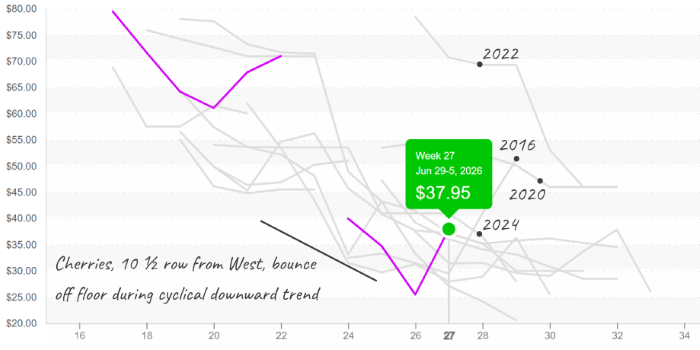
Cherry prices are climbing at a time of year when they typically begin falling. Strong Fourth of July demand coincided with a sharp drop in reported volume from Washington growers. As a result, average prices are up +33 percent over the previous week.
In addition, above-average temperatures during the growing season will likely shorten the production window for Pacific Northwest growers, and the forecast Western heat could compress harvest windows even further. Whether this week’s rally proves to be a fluke or the first sign of an early finish to the 2026 domestic cherry season remains to be seen.
Cherries
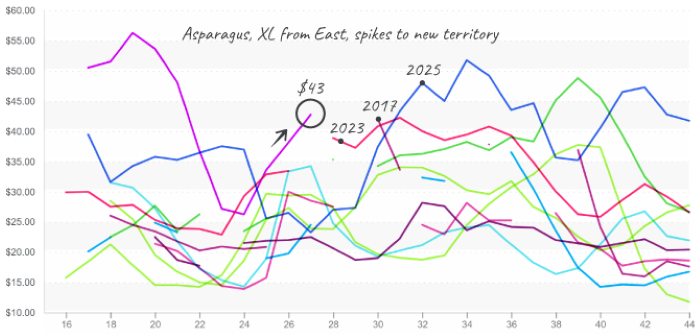
An asparagus supply gap is widening, and it is shaping up to be one for the record books. Up +20 percent over the previous week, grass prices clinch a ten-year high for week #27. Volume out of Mexico and Peru is below average for week #27 due to El Niño-related inclement weather, which is suppressing volume and forcing buyers to look elsewhere to cover shorts. Supply is forecast to remain very limited for the next three weeks.
Asparagus
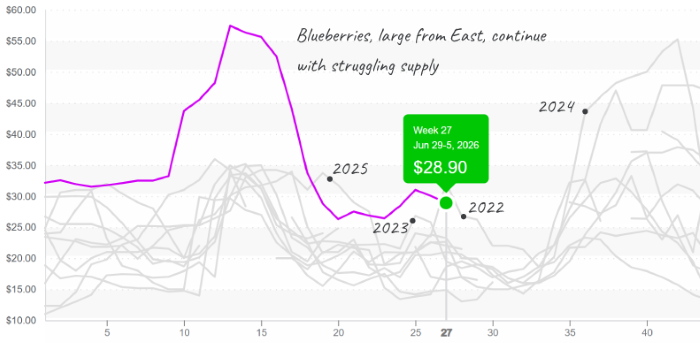
Blueberry production is struggling to find its feet as growers in Mexico wind down. In week #26, growers in California and the Pacific Northwest seemed on track to meet demand. However, multiple rain events interrupted harvest momentum just as supplies appeared poised to improve.
Quality is reportedly excellent, and as long as growers can avoid the effects of the forecast heat dome, availability and prices will probably improve over the next two weeks. If the fireworks weren’t enough excitement last week, growers now have the heat dome to keep them on their toes.
Blueberries
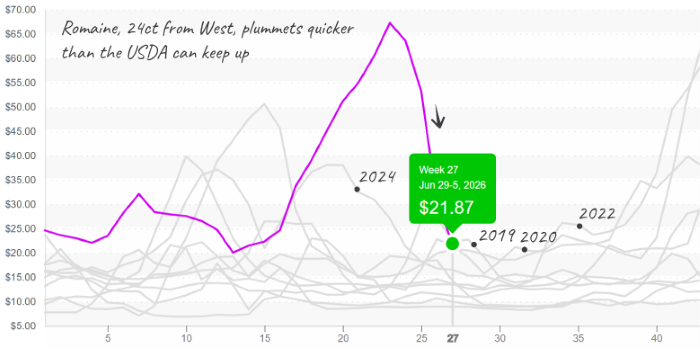
Iceberg and Romaine prices finally move closer to average after substantial week-over-week declines. Iceberg prices are down -48 percent and have officially shed their ten-year high status. Romaine, however, is still in historically unprecedented territory for week #27, but seems likely to relinquish that status within the next couple of weeks. That is, unless the rebuilding Western heat dome creates quality issues that delay relief for lettuce buyers.
Romaine
ProduceIQ saves you time and provides valuable information to increase your profits.
The ProduceIQ Index is the fresh produce industry’s only shipping point price index. It represents the industry-wide price per pound at the location of packing for domestic produce and at the port of U.S. entry for imported produce.
ProduceIQ uses 40 top commodities to represent the industry. The Index weights each commodity dynamically, by season, as a function of the weekly 5-year rolling average Sales. Sales are calculated using USDA Agricultural Marketing Service data on movement and prices. The Index serves as a fair benchmark for industry price performance.

News you need.
Join Blue Book today!
Get access to all the news and analysis you need to make the right decision --- delivered to your inbox.






Subscribe to our newsletter
© 2026 Blue Book Services. All Rights Reserved

