

















ProduceIQ: No green jacket for produce buyers this week
There is widespread concern within the produce industry that the Middle East effects have already begun to inflate the costs of production.

Images courtesy ProduceIQ
While Rory McIlroy claimed his second consecutive win at The Masters this weekend, U.S. negotiations with Iran did not enjoy the same triumph.
The U.S. and Iran were unable to reach an agreement to permanently end the conflict and reopen the Strait of Hormuz. It seems high energy prices and their spiteful after-effects are here to stay for the foreseeable future.
There is widespread concern within the produce industry that these effects have already begun to inflate the costs of production and will undo the strides the U.S. economy has made in quelling inflation across the board. To say the least, current circumstances make us want to hide out on some Georgia porch swing, pimento cheese sandwich in hand.
ProduceIQ Index: $1.40/pound, down -0.71 percent over prior week
Week #15, ending April 10th
Blue Book has teamed with ProduceIQ BB #:368175 to bring the ProduceIQ Index to its readers. The index provides a produce industry price benchmark using 40 top commodities to provide data for decision making.
Mother Nature, at least for now, gives produce markets a break from crisis fatigue with a relatively mild weather week. More much-needed rain for western growers, and above-average, but tolerable, heat in the East is forecast for week #15.
Spring transition is well underway on both coasts. Out West, most growers will wrap up the Yuma season over the next two weeks. In response, prices for most desert-grown commodities are rising. As Yuma winds down and Salinas ramps slowly, the market is entering the familiar spring handoff period.
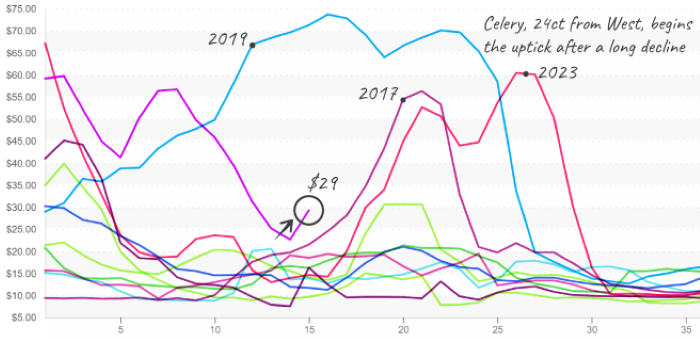
Celery continues to lead the move higher, up +32 percent over the previous week. Some celery supply issues are typically a recurring theme for produce markets in week #14. However, prices are already well above average due to extreme heat, prompting a swift end to Yuma’s growing season. Supplies from Salinas are forecast to ramp up slowly over the next few weeks and will gradually provide moderate relief to the extreme supply situation.
Celery
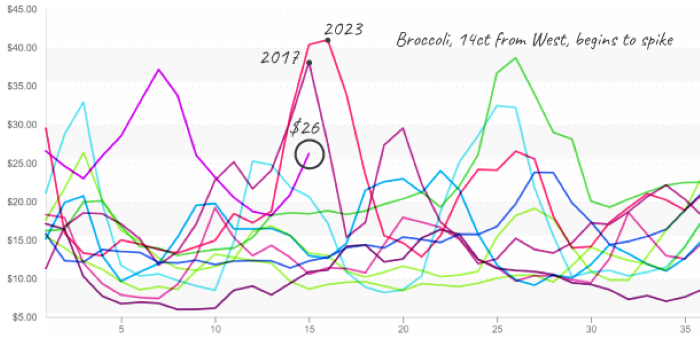
Following their wet-veg cousin’s lead, broccoli and cauliflower followed suit, climbing +24 percent and +19 percent, respectively, over the previous week. Unlike celery, cauliflower prices remain on the lower end of the historical spectrum, while broccoli prices are well above the average for week #14. A supply gap may form for both commodities this week, but it is forecast to be short-lived. Quality is fair to good, but shelf life is shortened due to heat-related challenges.
Broccoli
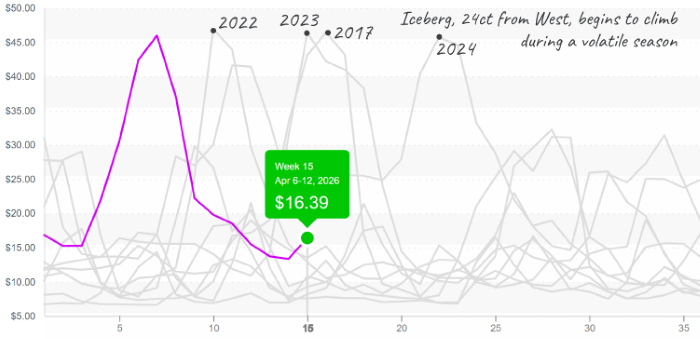
Elsewhere in the desert region, Iceberg prices rose by +18 percent over the previous week but remain close to average for week #14. Yields are down due to recent heat in Yuma and the seasonal transition. Nevertheless, Salinas is just around the corner and should bring stability back to supply and prices over the next two weeks.
Iceberg
Meanwhile in Florida, February’s freeze lingers even as spring bathes the region in warmth. Although the frigid cold of February is a distant memory for Florida growers entering into their spring season, for tomato growers and buyers, the historic cold isn’t so easy to forget. Spring tomato prices are shattering records. With Mexican growers in transition, relief is still a few weeks away, and even then, price normalization is expected to be gradual.
Tomatoes

ProduceIQ saves you time and provides valuable information to increase your profits.
The ProduceIQ Index is the fresh produce industry’s only shipping point price index. It represents the industry-wide price per pound at the location of packing for domestic produce and at the port of U.S. entry for imported produce.
ProduceIQ uses 40 top commodities to represent the industry. The Index weights each commodity dynamically, by season, as a function of the weekly 5-year rolling average Sales. Sales are calculated using USDA Agricultural Marketing Service data on movement and prices. The Index serves as a fair benchmark for industry price performance.
News you need.
Join Blue Book today!
Get access to all the news and analysis you need to make the right decision --- delivered to your inbox.







Subscribe to our newsletter
© 2026 Blue Book Services. All Rights Reserved

