

















ProduceIQ: Double whammy — government shutdown and Salinas weather woes
The federal government shutdown isn’t doing the fresh produce industry any favors. Meanwhile, the Salinas Valley is feeling the weather issues

Images courtesy ProduceIQ
The federal government shutdown isn’t doing the fresh produce industry any favors. With some USDA data releases on pause and inspection services running on fumes, growers are left flying blind just as fall harvest hits full stride.
Loan programs and certifications are on hold, leaving smaller farms to get creative—or just very patient. It’s not quite a food-safety free-for-all, but it does mean more guesswork, slower paperwork, and a touch of extra suspense in an industry that already operates on thin margins and tight deadlines.
Meanwhile, the Salinas Valley is feeling the weather side of that suspense. Heat and rain are driving rapid price gains for moisture-sensitive crops such as iceberg, romaine, cauliflower, and broccoli. Cauliflower and broccoli growers are contending with surging insect pressure from diamondback moths and aphids, alongside moisture-related quality challenges like pin rot.
Blue Book has teamed with ProduceIQ BB #:368175 to bring the ProduceIQ Index to its readers. The index provides a produce industry price benchmark using 40 top commodities to provide data for decision making.
ProduceIQ Index: $0.99/pound, +6.4 percent over prior week
Week #40, ending Oct 3rd
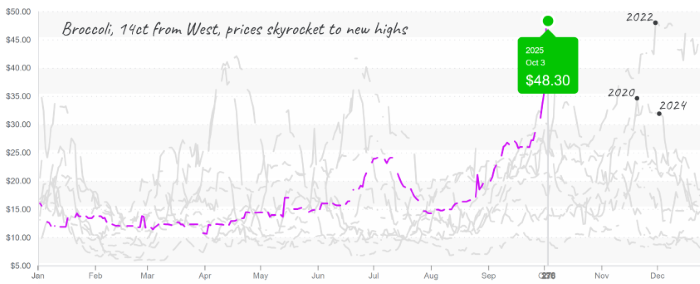
Broccoli prices are up +37 percent over the previous week, pushing 2025’s week #40 levels past 2022 to mark a ten-year high. Prices are expected to stabilize briefly before edging upward again as primary production transitions from Salinas, CA, to Mexico and Yuma, AZ.
Broccoli, 14ct, climb vertically to $48
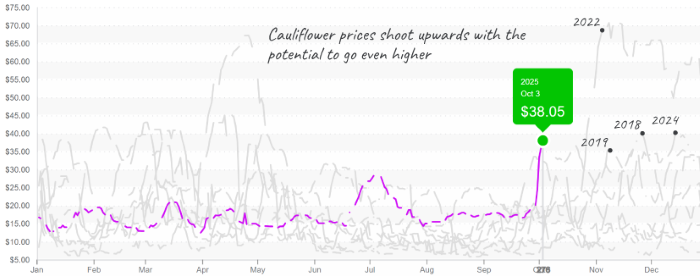
Cauliflower follows close behind. At $29, average prices sit just below a decade high. Up +71 percent over the previous week, cauliflower’s momentum now outpaces broccoli’s and shows little sign of slowing.
Cauliflower prices appear ready to test the highs of 2022
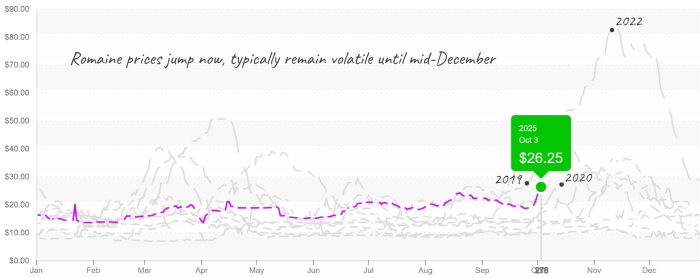
Lettuce isn’t immune. INSV and heat-related stress continue to squeeze yields, driving prices higher across varieties. Iceberg prices are up +83 percent, while romaine prices have surged +39 percent from last week. Supplies remain tight, and both prices and volatility are likely to persist as unseasonably warm and wet weather continues to disrupt harvests in the Salinas Valley.
Romaine, 24ct, prices begin a climb, though not anywhere near 2022 levels
ProduceIQ saves you time and provides valuable information to increase your profits.
The ProduceIQ Index is the fresh produce industry’s only shipping point price index. It represents the industry-wide price per pound at the location of packing for domestic produce and at the port of U.S. entry for imported produce.
ProduceIQ uses 40 top commodities to represent the industry. The Index weights each commodity dynamically, by season, as a function of the weekly 5-year rolling average Sales. Sales are calculated using the USDA’s Agricultural Marketing Service for movement and price data. The Index serves as a fair benchmark for industry price performance.

News you need.
Join Blue Book today!
Get access to all the news and analysis you need to make the right decision --- delivered to your inbox.






Subscribe to our newsletter
© 2026 Blue Book Services. All Rights Reserved

