


















Latest USDA Pesticide Data Program report finds more than 99 percent of samples below benchmark levels
WASHINGTON, Jan. 19, 2022 – The U.S. Department of Agriculture (USDA) today published the 2020 Pesticide Data Program (PDP) Annual Summary. The summary shows that more than 99 percent...
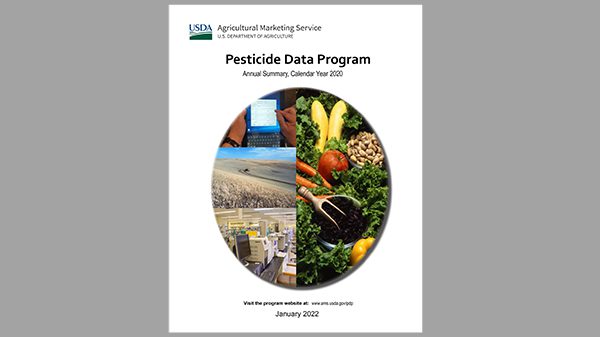
WASHINGTON, Jan. 19, 2022 – The U.S. Department of Agriculture (USDA) today published the 2020 Pesticide Data Program (PDP) Annual Summary. The summary shows that more than 99 percent of the samples tested had pesticide residues below benchmark levels established by the Environmental Protection Agency (EPA).
This report for 2020, issued by the USDA’s Agricultural Marketing Service (AMS), marks the 30th year of PDP results. Over the 30 years, USDA has tested 126 commodities, including fresh and processed fruits and vegetables, dairy, meat, poultry, grains, fish, rice, specialty products and water. PDP monitoring results for more than 310,000 samples through the years are available on the Pesticide Data Program website.
Each year, USDA and EPA work together to identify foods to be tested by the PDP on a rotating basis. In 2020, tests were conducted on 9,600 samples from 18 commodities of fresh and processed fruits and vegetables. AMS partners with cooperating state agencies to collect and analyze pesticide residue levels on the selected food commodities.
USDA tests a wide variety of domestic and imported foods, with a strong focus on foods that are consumed by infants and children. EPA relies on PDP data to conduct dietary risk assessments and to ensure that any pesticide residues in foods remain at or below levels that EPA has set. The data also provide regulators, farmers, processors, manufacturers, consumers and scientists with important insights into the actual levels of pesticide residues found on widely consumed foods.
The annual pesticide residue results are reported to the Food and Drug Administration (FDA) and EPA in monthly reports as testing takes place throughout the year. FDA and EPA are immediately notified if a PDP test discovers residue levels that could pose a public safety concern.
The 2020 data and summary can be found on the Pesticide Data Program page of the AMS website. Printed copies may be obtained by contacting the USDA Agricultural Marketing Service, Science and Technology Program, Monitoring Programs Division by e-mail at amsmpo.data@usda.gov.
For more information about pesticides and food, please visit the EPA website and the FDA website.
Image sources are either licensed or customer-provided.
News you need.
Join Blue Book today!
Get access to all the news and analysis you need to make the right decision --- delivered to your inbox.






Subscribe to our newsletter
© 2026 Blue Book Services. All Rights Reserved

