


















Blue Book New to Trade: New listings shift South
Texas, Florida, and Arizona accounted for 49% of the produce companies newly listed in Blue Book during the third quarter, up from 35% in Q1.
Texas, Florida, and Arizona accounted for 49 percent of the produce companies newly listed in Blue Book during the third quarter, up from 35 percent in the first.
California led new listings in the first quarter with 20 and added 11 in the third. Through Nov. 23, the three southern states have stayed close to their Q3 share, with 21 of the fourth quarter’s 46 new listings.
The southern share
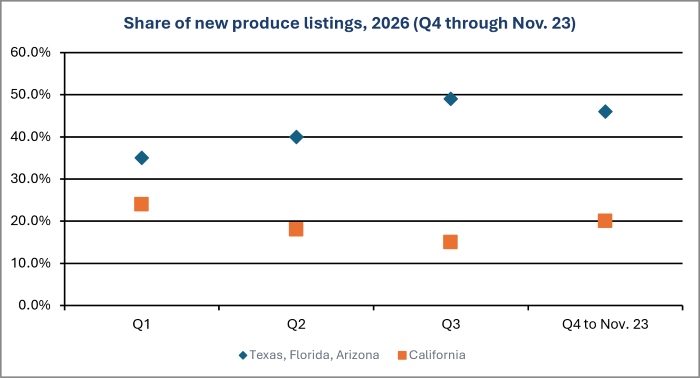
California’s share fell for three straight quarters, then recovered part of the ground in October, when it added eight listings; November so far has brought one.
State by state
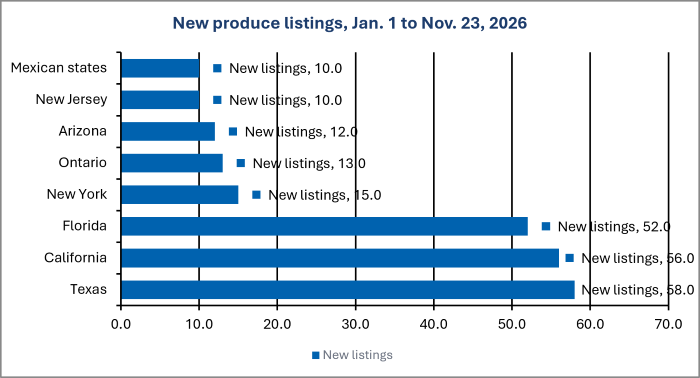
Texas has added more new produce listings than any other state this year, two ahead of California, after gaining ground in every quarter.
| State or region | Q1 | Q2 | Q3 | Q4 (to Nov. 23) |
| Texas | 14 | 17 | 18 | 9 |
| California | 20 | 16 | 11 | 9 |
| Florida | 14 | 14 | 14 | 10 |
| Arizona | 1 | 4 | 5 | 2 |
| New York | 4 | 7 | 2 | 2 |
| Ontario | 5 | 3 | 2 | 3 |
| New Jersey | 6 | 3 | 1 | 0 |
| Mexican states | 3 | 2 | 4 | 1 |
| All other | 16 | 22 | 18 | 10 |
| All new listings | 83 | 88 | 75 | 46 |
Arizona’s numbers are small, but it went from one new listing in the first quarter to five in the third. The Northeast moved the other way: New Jersey added six in the first quarter, one in the third and none since, and New York has added about one a month since its seven in the second quarter.
Outside the U.S., Ontario has added a few listings every quarter, and companies based in Mexican states, including Michoacán, Jalisco, Coahuila, and Chihuahua, have appeared in each period at one to four a quarter.
What it means for the trade
Texas and Arizona hold the busiest land crossings for Mexican produce, at Pharr, Laredo, and Nogales, so a rising count of new firms in both states fits a trade that keeps routing more winter supply north across the border. Our listing data doesn’t show what each new company handles or where its product comes from; the pattern is consistent with that flow, and readers should treat it as a lead worth checking rather than proof.
Florida has added 14 new listings in each of the first three quarters, and it leads November with six. That timing lines up with the start of the state’s winter vegetable season and the heavier Latin American import months through South Florida ports.
For sales and business-development teams, the practical read is about counterparties. More of the companies you haven’t traded with yet are setting up in the South, and many are new enough that their credit history is still short.
Check a new contact’s Blue Book rating and trade references before the first load ships, and expect more first-time inquiries from Texas, Florida and Arizona addresses this winter.
Find them in Blue Book
Blue Book members can search newly listed shippers, brokers, distributors and transportation firms by state, then check each company’s rating, trade practices and references before making contact.
About the data: counts cover produce companies that received a Blue Book listing in each period, grouped by the state or province on the company record. Q1 through Q3 are calendar quarters of 2026; the fourth quarter runs Oct. 1 through Nov. 23. Monthly counts in individual states are small, so single-month swings carry less weight than the quarterly pattern.
News you need.
Join Blue Book today!
Get access to all the news and analysis you need to make the right decision --- delivered to your inbox.






Subscribe to our newsletter
© 2026 Blue Book Services. All Rights Reserved

