



















October produce prices climb as volume slips
Fresh produce prices moved back into inflation in October, but higher prices couldn't keep shoppers buying at last year's pace, IFPA reports.
Images courtesy IFPA
Fresh produce prices moved back into inflation in October, but higher prices couldn’t keep shoppers buying at last year’s pace, according to the latest IFPA BB #:378962 Retail Produce Performance Series report from Circana and 210 Analytics.
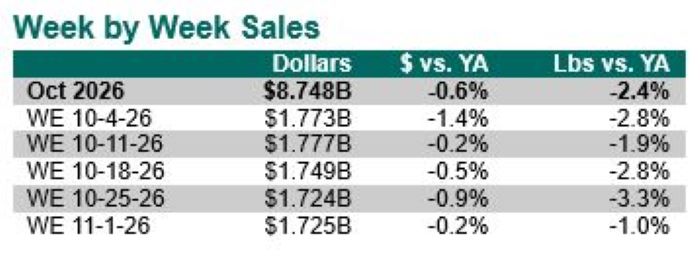
Produce departments rang up $8.7 billion in the five weeks ending Nov. 1, down 0.6 percent from a year earlier, while pound sales fell 2.4 percent.

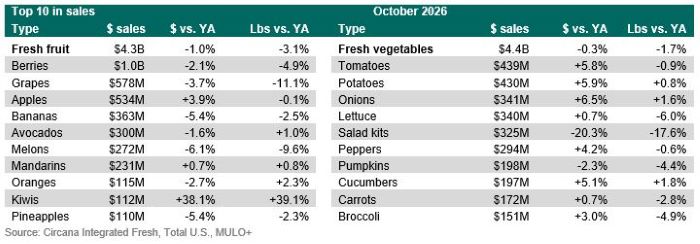
The average price per pound rose 1.8 percent to $1.86, ending September’s deflation. Fruit had the tougher month, with dollars down 1.0 percent and pounds off 3.1 percent; vegetable dollars held nearly flat (down 0.3 percent) on a 1.7 percent drop in volume.
Report author Anne-Marie Roerink, president of 210 Analytics, tied the soft volume to household budgets stretched again by fuel costs. The University of Michigan’s consumer confidence index averaged 48.0 in October, a five-month low, and regular gasoline averaged $4.28 a gallon in the month’s final week, up 41.3 percent year over year, according to the Department of Energy.
SNAP participation kept falling as well. USDA put enrollment at 36.1 million in July, 5.9 million fewer people than a year earlier, and a Pew Research survey found 21 percent of consumers had turned to a food bank or pantry in the past year.
Several commodities bucked the trend. Kiwifruit led all items in absolute dollar growth, adding $30.8 million on a 39.1 percent jump in pounds, and sweet potatoes added $24.5 million on 26.2 percent volume growth, extending strong runs from September.
Tomatoes and potatoes each gained $23.9 million, though price drove the tomato increase. Onions and cucumbers grew both dollars and pounds, and fall items pomegranates and pears posted volume gains of 25.9 percent and 13.0 percent, respectively.
Grapes, the second-largest fruit category at $578 million, fell 3.7 percent in dollars and 11.1 percent in pounds. Melons and bananas also slipped, and berries, the top seller at $1.0 billion, dropped 2.1 percent in dollars.
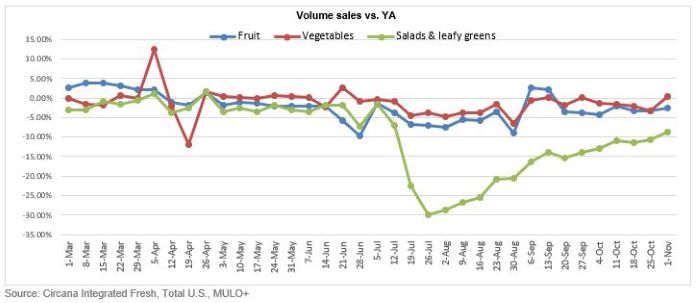
Salads and leafy greens remain the department’s biggest drag. Category sales fell 10.5 percent to $992 million, and salad kits alone dropped 20.3 percent.
The category has trailed year-ago levels since the Cyclospora outbreak that began in mid-July, but the gap is closing: weekly volume went from 13.0 percent below a year ago in the week ending Oct. 4 to 8.7 percent below in the week ending Nov. 1, the smallest shortfall since the outbreak.
Frozen fruits and vegetables outpaced fresh, growing dollars 5.0 percent and pounds 2.2 percent to reach $1.0 billion. Across the store perimeter, seafood was the only department to grow dollars.
Looking ahead, Circana’s Holiday Purchase Intentions report finds shoppers planning earlier and budgeting more carefully, yet nearly twice as many expect to spend more this season as expect to spend less.
Thirty percent say higher prices will push them toward sales, deals, and coupons, and 29 percent plan to buy fewer items. Circana expects parents, Gen Z and Millennials to drive growth in a holiday season it describes as price-led, front-loaded and polarized.
News you need.
Join Blue Book today!
Get access to all the news and analysis you need to make the right decision --- delivered to your inbox.




Subscribe to our newsletter
© 2026 Blue Book Services. All Rights Reserved

