

















The buyer is not here for story time
Sellers have heard some version of "we need to tell our story" for decades, and it's still frequently repeated today. Here's a better idea.
Courtesy Karen Nardozza, Moxxy
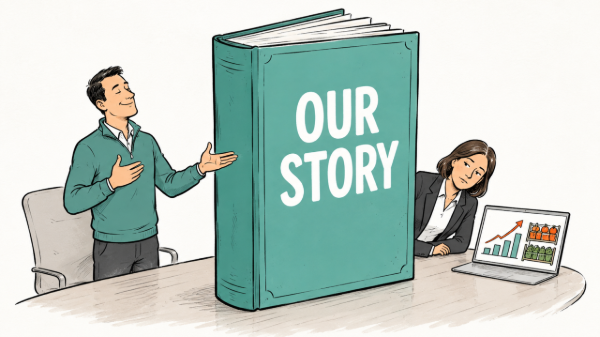
What’s wrong with the common advice that says fresh food producers need to “tell our story”?

Those of us in marketing for agricultural-based products have been hearing some version of “we need to tell our story” for well over a decade, and it’s still frequently repeated today.
Here’s why it’s wrong (at worst). And at best, not the priority…
Your target audience, often a retail buyer, either doesn’t know about your brand, or doesn’t care—at all.
Marketing’s job, among other things, is to get your audience to notice you and care.
And attempting to do that by launching into storytelling—which mostly looks and sounds like talking about yourself and your history—has little to no chance of working.
- Founded in 1949? So what. How is that relevant today to your buyer?
- Three generations strong? Not unique. You just described most family farms.
- From our family to yours? You and several thousand other food companies.
- Deeply committed to quality? As opposed to all those companies proudly committed to mediocrity?
So, unless your organization’s purpose is ag education and advocacy, leave behind the well-intentioned but poor advice to tell your heritage and operations story.
I am not implying heritage and operational details are irrelevant. But those topics need to earn their place and be appropriately prioritized in your messaging hierarchy—and that’s the nuance I see many brands getting wrong.
What’s the better advice?
Don’t begin with: What story do we want to tell?
Begin with:
- Who exactly are we trying to influence?
- What do they care about?
- What problem are they trying to solve?
- What makes us valuable to them?
- What can we offer that current suppliers cannot?
- What proof do we have?
- Why should they act now?
Your story earns a place in the marketing only when it helps answer the buyer’s questions.
If three generations of experience make you better at selecting varieties, managing supply or anticipating quality issues, say that.
If being family owned allows customers to reach a decision-maker quickly, say that.
If your new packinghouse improves shelf life, expands capacity, or gives retailers more packaging options, say that.
Translate the facts into value. Otherwise, it’s trivia.
Your retail buyer is not sitting at a desk thinking, “I really wish another supplier would tell me how their grandfather started with 20 acres and a dream.”
The buyer is thinking about sales, margins, pricing, shrink, gapping, and whether your program will make the category—and the buyer—more successful.
That is the story your marketing needs to tell.
Your company does not have to be the hero. In fact, it probably shouldn’t be. Make the buyer, the retailer, or the foodservice operator the point of the story.
Position your brand as the reason they get a better outcome. Then use the relevant parts of your history to prove you can deliver it.
Stop telling prospects your story and expecting them to determine why it matters.
Tell them specifically and directly why you matter—and use your story to prove it.
This column was originally posted by Karen Nardozza of Moxxy Marketing BB #:341508 on LinkedIn.
News you need.
Join Blue Book today!
Get access to all the news and analysis you need to make the right decision --- delivered to your inbox.






Subscribe to our newsletter
© 2026 Blue Book Services. All Rights Reserved

