



















From Credit to Cash: Building a better process
Every receivable begins long before an invoice is issued; it begins with a credit decision.

In this article
The companies that consistently outperform in working capital management understand collections are only one component of an effective credit-to-cash process. Every step—from customer onboarding through final payment—either reduces or increases risk.
This type of disciplined approach is reflected in the industry’s overall performance and outlined below in Blue Book’s accounts receivable (A/R) aging contributor data.
But, even in relatively stable market conditions, every credit department encounters receivables beginning to age beyond expectations. The difference is not whether these situations occur, but how quickly they are identified and managed.
Before exploring strategies for improving collections and accelerating cash flow, it’s helpful to first understand how the industry is performing and where today’s greatest opportunities—and early warning signs—exist.
For companies where aging falls outside of industry benchmarks, this should be viewed as an opportunity to evaluate and strengthen the credit-to-cash process.
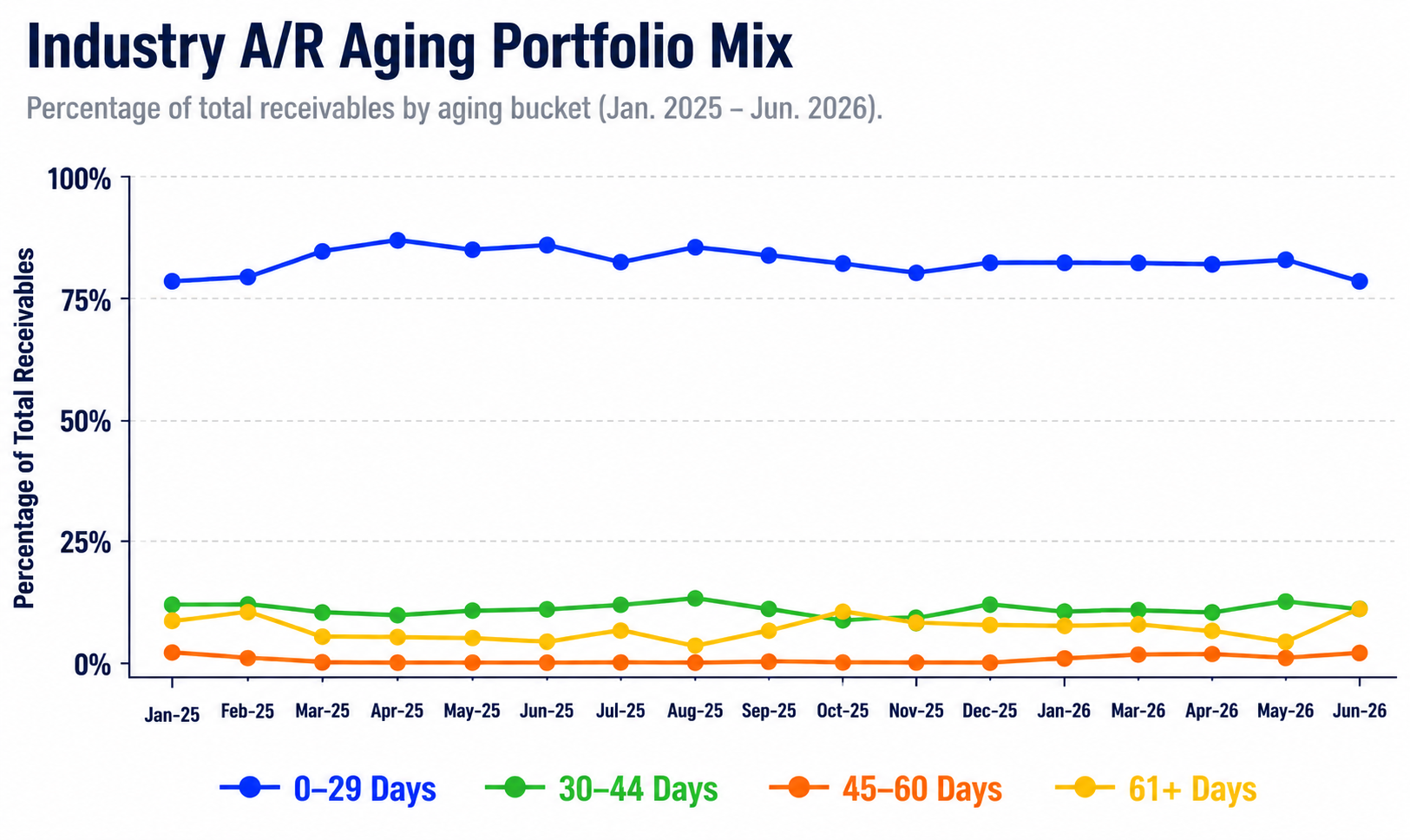
During the past 18 months, more than 80% of all industry receivables consistently remained within 29 days, while another 8 to 10% aged between 30 and 44 days.
Collectively, the vast majority aged within expected payment terms. Most trading relationships remain healthy with disciplined credit-to-cash practices supporting strong liquidity throughout the industry.
At the same time, the most recent data warrants attention. June 2026 marks the first meaningful softening in the 0-29-day aging bucket, accompanied by an increase in receivables exceeding 61 days.
While one month does not establish a trend, it’s precisely the type of movement credit professionals should monitor closely. Small shifts in portfolio aging often provide the earliest indication broader payment behavior may be changing.
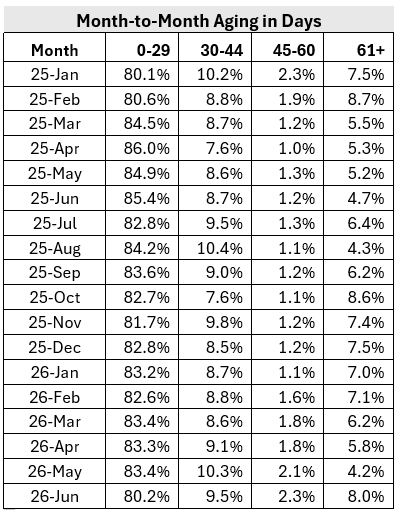
The data also affirms one of the most important principles in commercial collections: once an invoice progresses beyond 45 days, it becomes part of a much smaller segment of the overall receivables portfolio, but one where the likelihood of prompt recovery declines significantly.
What begins as a routine collection effort can quickly evolve into a higher-risk recovery situation.
The greatest opportunity to improve cash flow isn’t simply working more accounts, it’s identifying and prioritizing the right accounts sooner.
Organizations that move beyond age-based collections and adopt a risk-based collection strategy recover cash faster, reduce bad debt exposure, and enable their credit teams to focus efforts where they create the greatest financial impact.
Collection Probability
There isn’t a single industrywide nonpayment probability metric because it depends on factors such as sector, customer quality, invoice disputes, and a creditor’s collection process.
However, trade credit, commercial collections, and accounting research all point in the same direction: once an invoice reaches 60-plus days, the risk of nonpayment increases sharply as the decline in collectability accelerates.
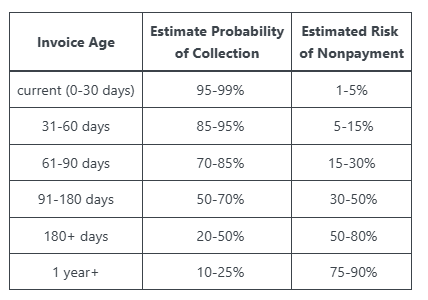
These ranges are synthesized from commercial collections data and trade credit benchmarks. Studies consistently show that the probability of collection falls significantly after 60 to 90 days and continues to deteriorate the longer an account remains unpaid.
Credit-to-Cash
Companies with the strongest collection performance rarely rely on collections alone. Instead, they manage each stage of the customer lifecycle.
1. Customer Qualification – Every successful collection starts before the first order: verify company information; review Blue Book ratings and scores; evaluate ownership, financial strength, payment history, and industry reputation; and establish appropriate credit limits and payment terms. The best collection is the invoice that never becomes a collection problem.
2. Order Management – Once credit has been extended: confirm purchase orders; verify delivery instructions; document shipment acceptance; and address discrepancies immediately. We think collections equals financial troubles, but many collection issues originate from operational missteps.
3. Accurate Invoicing – For invoicing: send invoices promptly and ensure pricing, quantities, other charges, and terms are correct. Even small invoicing errors can delay payment by weeks.
4. Early Accounts Receivable Management (0-29 Days) – During this stage: send statements; resolve disputes quickly; monitor payment behavior; and stay on top of higher risk accounts. More than 80% of industry receivables are resolved during this period.
5. Active Collection (30-44 Days) – As invoices age, pursue the following: increase customer contact; confirm payment dates; escalate unresolved disputes; and monitor for changing payment behavior. This is often where emerging credit problems become visible.
6. Credit Review (45-60 Days) – Now is the time to reassess exposure; ask: should additional shipments continue? Has payment performance changed? Are other suppliers experiencing similar delays? Has the customer’s Blue Book score changed? Are there new claims, lawsuits, or early warning indicators? This is where industry intelligence becomes invaluable.
To get access to industry A/R data on your customers, learn more here: A/R Aging Contribution Program. You can also begin a structured Blue Book Courtesy Contact program for customers whose balances reach this aging interval to reinforce communication before accounts become seriously delinquent (learn more here: Send A Courtesy Contact).
7. Third-Party Collections (61+ Days) – Blue Book contributor data consistently shows that receivables beyond 60 days represent 4 to 8% of total industry receivables. It doesn’t sound like much, but if you’re a $25-million-dollar company, that’s $1 to $2 million at extreme risk.
When communication breaks down, payment commitments are repeatedly missed or balances continue to grow, third-party collections should no longer be viewed as a last resort—they become the next logical step in protecting cash flow.
Consider filing a Blue Book claim to strengthen collection efforts before the account deteriorates further. Filing costs are minimal and vary based on membership level and participation in our A/R Contributor Program (learn more here: File A Claim).
Acting earlier often produces better recovery rates while preserving business relationships whenever possible.
The Value of Industry Intelligence
The most successful credit departments don’t rely solely on their own receivables. They leverage market intelligence. Blue Book’s A/R Aging Program allows contributors to see real-time industry payment trends of their own customer base.
Instead of asking: “How is this customer paying me?” contributors can also ask: How are they paying everyone else? Are payment trends improving or deteriorating? Is this account becoming a broader industry concern? Should credit exposure be adjusted?
These answers often become available weeks—or even months—before traditional financial reporting or public filings reveal trouble.
Contributor participation gains access to multiple risk management tools and also receives reduced collection assistance rates. Every A/R file shared improves payment visibility, strengthens Blue Book scores, enhances early warning capabilities, and helps companies make more informed credit decisions.
The Bottom Line
Your goal is to predict collection risk before an invoice becomes past due, rather than reacting after collectability has already begun to deteriorate.
The strongest credit departments don’t simply recover receivables; they manage the entire credit-to-cash lifecycle. They qualify customers, monitor payment performance, communicate early, leverage industry intelligence, and recognize when specialized assistance is warranted.
The best collection strategy isn’t collecting old invoices—it’s preventing good invoices from becoming old invoices in the first place.

News you need.
Join Blue Book today!
Get access to all the news and analysis you need to make the right decision --- delivered to your inbox.








Subscribe to our newsletter
© 2026 Blue Book Services. All Rights Reserved

